


| As Featured In: |
|
|
Master the King of All Exercises
Deadlifting Secrets 101 Everything you need to know about this complex exercise. Free Video Training |
![]() Show and Go: High Performance Training to Look, Feel, and Move Better |
|||
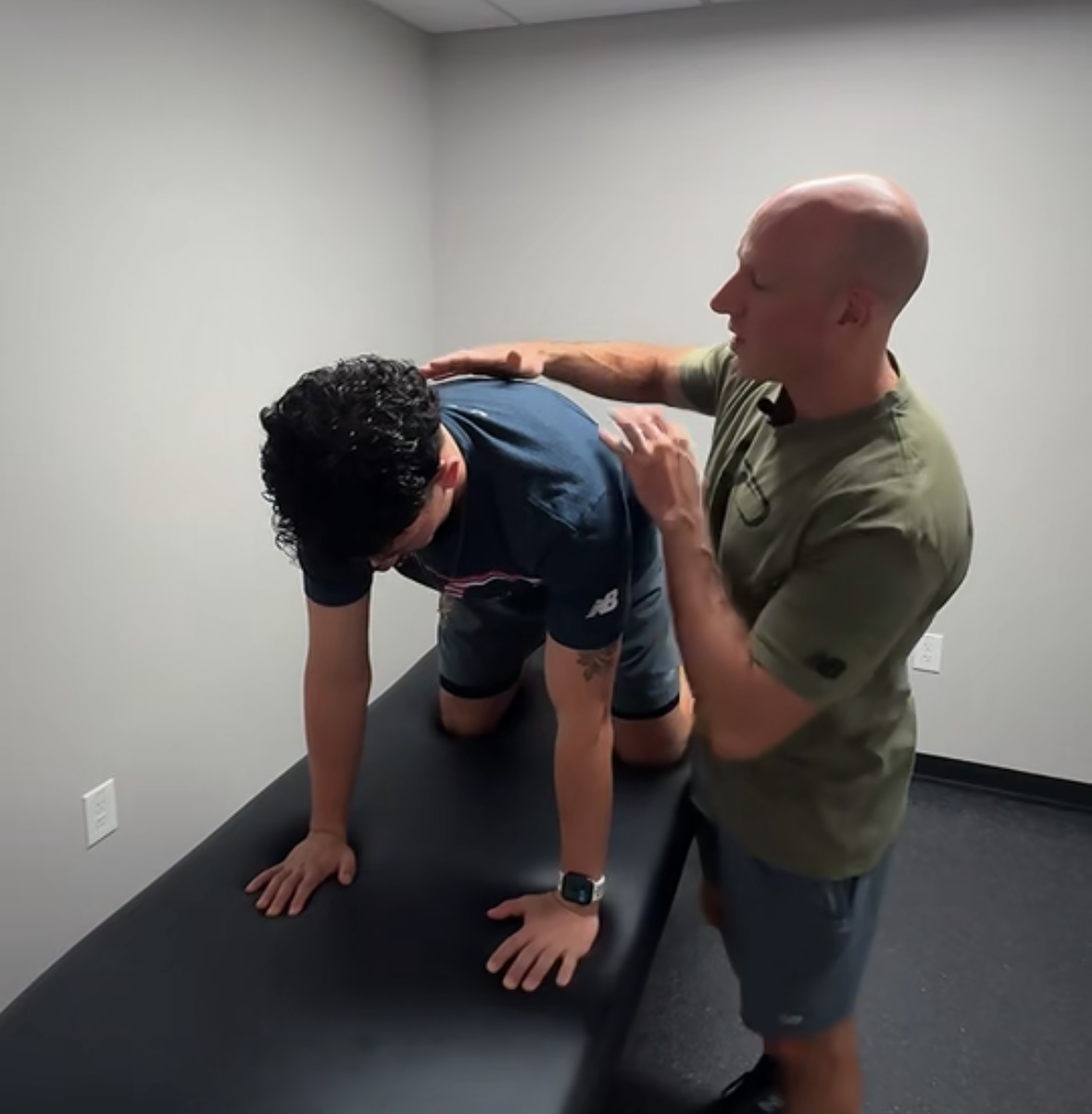
Increasing Pitching Velocity: What Stride Length Means and How to Improve It – Part 3Written on February 22, 2012 at 8:06 am, by Eric Cressey In part 1 of this series, I touched on some of the mechanical factors one must consider in relation to increasing stride length in pitchers. Then, in part 2, I got discussed physical factors – hip mobility and lower-body strength/power – that govern how far you can stride. In wrapping up today with part 3, we’ll work our way up the kinetic chain to discuss three more physical factors that control stride length. 3. Rotary Stability – As I discussed in my recent article at T-Nation, What I Learned in 2011, hip mobility “sticks” better when you have adequate rotary stability, so we’ve been doing more of our core stability exercises in more “extreme” positions of hip mobility. If you’re going to push the limits of hip abduction, internal, and external rotation range of motion, you need to be sure that you have adequate rotary stability to be stable in these positions in weight-bearing and not destroy the spine. Anybody can just get into these positions in slow speed, but not everyone can control the body precisely with a combination of isometric and eccentric muscle action at the high velocities we see with pitching. Additionally, many of the big-time long stride guys rely heavily on controlling lumbar spine hyperextension as they ride the back hip down the mound. This is something you’ll see if you watch the deliveries of smaller, athletic guys like Tim Lincecum, Tim Collins, and Trevor Bauer. If they don’t maintain adequate anterior core function, they’ll wind up with extension-based back pain in no time. 4. Thoracic Mobility – Throwing and hitting (and really any rotational challenge like a hockey slapshot or tennis stroke) present a unique challenge to an athlete: the hips and shoulders are temporarily moving in opposite directions. This creates separation, which allows an athlete to store elastic energy and create velocity via the stretch-shortening cycle. The first issue to consider is that not all separation is created equal. You can create separation with the hips and lower back – and jack up a lumbar spine over time. The goal is to having adequate thoracic spine mobility to ensure that this separation occurs higher up (and engages the upper extremity well). The second issue is that the more you push the limits of hip mobility, the more you must push the limits of thoracic mobility. We’ve always heard “equal and opposite” when it comes to the throwing arm and glove arm, but the truth is that it probably apply to the lower half and thoracic spine as well. You simply don’t see guys with terrible thoracic mobility getting way down the mound, as that lack of thoracic mobility would cause them to leak forward with the upper body. I covered this in part 1, but the Cliff’s Notes version is that the head doesn’t stay behind the hips long enough, so throwers lose separation. The third issue is that poor thoracic mobility will really interfere with getting an adequate scap load, so the arm speed will be slower. Throwing with a poorly positioned scapula is like trying to jump out of sand; you just don’t have a firm platform from which to create force. A very basic thoracic spine mobility drill that would be a “safe” bet for most throwers would be the quadruped extension-rotation. This drill doesn’t crank the shoulder into excessive external rotation, which may be a problem for the really “loose” arms in the crowd. Progressions for the really stiff pitchers would be the side-lying windmill and side-lying extension-rotation. I also like the yoga plex, a drill I learned from Nick Tumminello, as a means of syncing everything up with a longer stride. Note: be sure to read this shoulder mobility blog on why not all thoracic spine mobility drills are created equal for throwers! 5. Quick Arm – When I say that you have to have a quick arm to have a long stride, I really just mean that you need some upper body power to make things work. The longer the stride, the quicker your arm must be to catch up in time to create a downward plane and throw strikes. You simply don’t see guys with long strides competing at high levels unless they have a quick arm that can catch up to the lower body. When a guy’s arm isn’t quick enough to catch up to his lower half, you see him miss up and arm side.This type of thrower would be better off shortening up his stride (at least temporarily) and spending more time on good throwing programs to increase arm speed. This is one reason Justin Verlander is great. If you watch him, he’s not an insanely long stride. Rather, he’s shorter with it, and much stiffer on his landing leg to create an awesome downward plane. Plus, he actually does have a ridiculously quick arm and outstanding secondary stuff. A lot of pitching coaches would try to lengthen his stride – and while this might work, I don’t know about you, but I think overhauling a Cy Young winner’s mechanics is silly. The “long stride, slow arm” issue is (in my experience) most common in young, lax players who have the joint range-of-motion and just enough stability to get a long stride, but don’t have adequate arm speed to catch up. This is really common in the 14-17 age ranges, and I think it’s one reason why so many of these kids respond incredibly favorably to long toss; it teaches their arms to go faster and keep up with their strides. Conversely, as you start to deal with 18-year-olds and older (or kids who have grown quickly), you start to see that preparing everything below the arm is arguably more important than arm speed. You don’t pitch in college or professional baseball unless you have a reasonably quick arm, and getting more aggressive with the lower half to stride longer is often exactly what guys need to make the big velocity jump. Likewise, when guys don’t take care of the lower half, but continue on aggressive throwing programs, they often wind up with velocity drops, injuries, or control issues because they’ve lost the separation that made them successful. Closing Thoughts While a long stride can certainly be advantageous in the throwing motion, as I’ve shown in this series, forcing it when you don’t have the right physical preparation or mechanical coaching in place can actually hurt an pitcher’s performance and health. Remember that the best changes are subtle ones; in other words, you might increase a stride by six inches over the course of a year, not in a single session. Sign-up Today for our FREE Newsletter and receive a four-part video series on how to deadlift! Strength and Conditioning Stuff You Should Read: 2/21/12Written on February 21, 2012 at 9:10 am, by Eric Cressey I’m back from a fun trip to California, but as you might expect, I’ve got quite a bit on my plate as I play “catch-up.” Luckily, I’ve got some reading ready for you: Q&A: Is Static Stretching Good? – This is an outstanding, thorough blog post from Mike Robertson; it’s definitely worth a read. The Fascial Knock on Distance Running for Pitchers – With spring training and the college seasons underway, loads of ignorant coaches are forcing their pitchers to run long distances. In this old post of mine, I review Thomas Myers’ presentation on fascial fitness and apply it to this debated point in pitching development. Diamondbacks CEO Won’t Let His Cancer Change the Best Workplace in Sports – I think this is a fantastic article at Yahoo Sports for not just any baseball fan, but any business owner. The D-Backs won 94 games last year (sixth most in baseball), but did it with the sixth lowest payroll. It goes to show you that treating people right and building a strong culture in your organization really matters. Sign-up Today for our FREE Newsletter and receive a four-part video series on how to deadlift! What I Learned in 2011Written on February 18, 2012 at 1:53 am, by Eric Cressey This marks the fifth year that I’ve been writing this year-end series for T Nation. In my first installment, I was fresh out of graduate school, so I drew heavily from the research I’d seen. Nowadays, while I still read a lot of research, more of my “findings” have come from being in the trenches (where I’ve also acquired a receding hairline). Hopefully this year, you’ll find a nice blend of the two. Increasing Pitching Velocity: What Stride Length Means and How to Improve It – Part 2Written on February 16, 2012 at 11:18 am, by Eric Cressey In part 1 of this series, I discussed the fact that – all other factors held constant – increasing stride length will improve pitching velocity. Unfortunately, when you simply tell a pitcher to stride further down the mound, there are usually some unfavorable mechanical consequences that actually hinder pitching velocity. So, be sure to read that piece before continuing on here. That said, sometimes, physical limitations can make it difficult to acquire a longer stride. To that end, I wanted to use this second installment to begin to outline the top five limiting factors for those looking to get down the mound and throw harder. 1. Hip Mobility If you’re going to really get down the mound, you need outstanding adductor length on both the lead and trailing legs. That goes without saying. While we outline several options on our Assess and Correct DVD set, the split-stance kneeling adductor mobilization is definitely my favorite, as it improves adductor length in both hip flexion and extension: Just as important, players need to stop “hanging out” in adduction in sitting and standing. I wrote about this in a bit more detail in my What I Learned in 2010 article (point #3). This is incredibly common in right-handed throwers, in particular. If your resting hip posture looks like this, fix it! We use a variety of drills from the Postural Restoration Institute to help address the issue, but suffice it to say that you’ll be swimming upstream unless you learn to stop standing/sitting like this! Additionally, you need adequate length of the trailing leg hip flexors – particularly rectus femoris – to ensure that you don’t cut off hip rotation prematurely. I like the wall hip flexor mobilization for this purpose. Keep in mind that we perform the exercises on both the front and trailing leg, as many pitchers will have substantial knee flexion deficit on the front leg secondary to the stress of landing/deceleration. Third, you need adequate hip internal and external rotation on both sides. Hip external rotation range-of-motion on the trailing leg is particularly important to allow force to be applied over a longer distance. Additionally, hip internal rotation is key on the front side, as enables a thrower to utilize the lower half more efficiently in deceleration. Those without adequate internal rotation on the front side often cut their arm paths short and miss high with pitches – and put much more stress on their arm because the deceleration “arc” is shorter. External rotation is best gained through glute activation drills (supine bridges, side-lying clams, x-band walks) in conjunction with simply externally rotating the femur during the split-stance kneeling adductor mobilization I featured earlier. For internal rotation, I like a gentle knee-t0-knee stretch/mobs (assuming no medial knee issues) , and bowler squats as a follow-up to get comfortable with the pattern. Of course, all these mobility drills must be complemented by quality soft tissue work: foam rolling and, ideally, manual therapy with a qualified practitioner. So, as you can see, adequate hip mobility for optimizing pitching velocity must take place in a number of planes. Additionally, you need to remember that mobility is always influenced by musculo-tendinous. capsular, ligamentous, and osseous (bony) restrictions, so no two pitchers will be the same in their needs. And, some pitchers simply may not have the bone structures to get into certain positions that are easy for other pitchers to achieve. 2. Lower-Body Strength/Power You can’t discuss lower-body mobility without appreciating the interaction it has with lower-body strength and power. You see, mobility is simply your ability to get into a certain position or posture. Flexibility is simply the excursion through which a joint can move. What’s the problem? Flexibility doesn’t take into account stability. Just because you can get your joints to a certain position in a non-weight-bearing scenario doesn’t mean that you’ll be able to achieve that same position when you’re in a weight-bearing position, trying to throw 95mph as you move downhill. So, I’ll put my point in big, bold letters: Pitchers need strength to have mobility.Truth be told, building lower body strength in throwers isn’t tough. You use all the basics – single-leg work, deadlift variations, squat variations (when appropriate), sled work, pull-throughs, glute-ham raise, hip thrusts, glute bridges, etc. – but just work to make sure that they are safe for throwers (e.g., use the front squat grip instead of the back squat grip). Strength isn’t just a foundation for mobility, though; it’s also a foundation for power. You can’t apply force quickly if you don’t have force! So, once players have an adequate foundation of strength, they can benefit more from rotational medicine ball exercises and plyos in the frontal/transverse planes to learn to better apply force outside the sagittal plane. Make no mistake about it; having adequate strength/power to push off and rotate aggressively – not to mention decelerate the body on the front leg – is essential to outstanding pitching velocity. I’ll be back soon with Part 3 of this series. In the meantime, if you’re looking for more hip mobility ideas for baseball players, check out Assess and Correct: Breaking Barriers to Unlock Performance. Sign-up Today for our FREE Baseball Newsletter and Receive a Copy of the Exact Stretches used by Cressey Performance Pitchers after they Throw! Increasing Pitching Velocity: What Stride Length Means and How to Improve It – Part 1Written on February 14, 2012 at 8:01 am, by Eric Cressey Ask almost any pitcher, and he’d tell you that he’d love to increase his stride length on the mound in hopes of increasing pitching velocity. And, this is certainly an association that has been verified by both anecdotal and research evidence for years. Look back to the best pitchers of former generations, and they figured this out even without the benefit of radar guns. On the anecdotal side of things, hitters often comment on how pitches “get on them faster” with a guy who strides further down the mound. This is a no brainer: a pitcher who releases the ball closer to the plate has a competitive advantage. That’s perceived pitching velocity. However, what about actual velocity – meaning what the radar gun says? The truth is that it’s somewhat tricky to prove specifically that a longer stride directly equates to better actual velocity, as it really depends on how the pitcher gets to that point. You see, a pitcher can effectively delay his weight shift to create better “separation;” in fact, keeping the head behind the hips longer correlates highly with pitching velocity. This separation is the name of the game – and he’d throw harder. Or, that same pitcher could simply jump out – letting his body weight leak forward prematurely – and completely rob himself of separation and, in turn, velocity. So, that’s the first asterisk to keep in mind: it’s not just where you stride, but also how you stride there. Additionally, in that second scenario, this modification may cause a pitcher to shift his weight forward excessively and wind up landing too much on his toes. While the point on the foot at which the weight should be centered is certainly a point of debate among pitching coaches, it’s safe to say that they all agree that you shouldn’t be tip-toeing down the mound! Lastly, even if the weight shift is delayed perfectly, a pitcher still has to time up the rest of his delivery – when the ball comes out of the glove, how high the leg kick is, etc – to match up with it in “slightly” new mechanics. These adjustments can take time, so the velocity improvements with a long stride may not come right away because other factors are influenced. Of course, keep in mind that not every hard thrower has a huge stride. Justin Verlander doesn’t get too far down the mound, but he’s still done okay for himself! Verlander seems to make up the difference with a ridiculously quick arm, great downward plane at ball release, and outstanding hip rotation power. There’s no sense screwing with someone who is a reigning Cy Young and MVP – and has two career no-hitters under his belt. However, YOU have to find what works best for YOU.
So, without even getting to my list, you can say that mechanical proficiency is the #1 factor that influences whether a long stride will improve your pitching velocity. Dial in what needs to be dialed in, and it could work wonders for you – if your body is prepared. To that end, in part 2 of this series, I’ll outline five physical factors that will help you improve your stride length and increase pitching velocity. Interested in learning more about the throwing shoulder? Check out Optimal Shoulder Performance: From Rehabilitation to High Performance!
Sign-up Today for our FREE Baseball Newsletter and Receive a Copy of the Exact Stretches used by Cressey Performance Pitchers after they Throw! Strength and Conditioning Stuff You Should Read: 2/12/12Written on February 12, 2012 at 7:49 pm, by Eric Cressey I thought I’d kick off the week with some recommended strength and conditioning reading: Michael Mullin on his Postural Restoration Institute Experiences – I thought this was a great “random thoughts” piece from Michael Mullin, who has been a great resource to me as I’ve learned more and more of the PRI methodology. Massage and Inflammation Due to Muscular Damage – Patrick Ward looks at some recent research on the benefits of massage – and some of the proposed physiological mechanism through which we benefit from it. Cueing: Just One Piece of Semi-Private Success – Part 1 and Part 2 – I wrote this two-part series back in 2010 to highlight some of the differences between cueing and coaching – and how appreciating that difference had made me more effective as a coach (on top of helping Cressey Performance grow). Sign-up Today for our FREE Newsletter and receive a four-part video series on how to deadlift! Exercise of the Week: Box Jump with 1-leg LandingWritten on February 9, 2012 at 8:43 pm, by Eric Cressey For this week’s exercise of the week, I had some help from Miami Marlins pitcher and Cressey Performance client Steve Cishek, as well as Stack.com and New Balance Baseball. Check it out: A lot of folks do lower-level single-leg ploys and bilateral jumping/landing variations, but many folks never get around to combining the two. This is a great option for those looking to take things to the next level. Just make sure you’re conservative with box height, for safety sake.
Sign-up Today for our FREE Newsletter and receive a four-part video series on how to deadlift! Baseball Injuries: What to Expect in the Next Few MonthsWritten on February 7, 2012 at 9:04 pm, by Eric Cressey With football season now officially over, loads of sports fans are now turning their attention to the day that pitchers and catchers report in a few weeks, signifying the start of spring training and a new Major League Baseball season. Truth be told, many college programs will have already started their seasons – and many high school programs will be playing official games before the big leaguers start having regular season contests. Unfortunately, with the start of a new season comes injuries…and lots of them. In fact, according to researchers who examined MLB injury statistics from 2002 through 2008, professional baseball players are 10.6 times more likely to get injured in April than they are in September. In other words, they are far more likely to get hurt because they haven’t prepared adequately for specificity than because they’ve had too much specificity. Think about that for a second. By the time September rolls around, most MLB players have logged 150 games between spring training and regular season play. On a regular basis, they’ve fouled balls off their feet, gotten hit by pitches, made 100 slides, attempted dozens of diving catches, and sprinted full-tilt when they aren’t warmed-up thoroughly after standing around doing nothing for a few innings. Pitchers have logged hundreds of innings, in some cases, and catchers are sick of squatting for hours on end. Yet, guys are dropping like flies in April, when they’re supposed to be the most fresh. Huh?There are three legitimate reasons that this is happening. First, the weather is colder – which means it’s tougher for guys to stay warm and loose during early season games. This doesn’t explain the high injury rates we see in spring training, though, as all games take place in Arizona and Florida. Second, guys may be ramped up too quickly. Too many swings or throws in a short period of time may be the problem – but this really isn’t something that can be changed, as guys need to become game ready, getting their timing, coordination, and mechanics down cold while they’ve got proper coaching at hand. Third (and this is the main message of this article), guys simply aren’t preparing correctly in the off-season with their baseball strength and conditioning programs. They may not be showing up with the right mobility and stability in the right places, or they may simply be waiting too long to start throwing, hitting, or sprinting. This happens all the time at the high school, college, and professional levels. In the high school ranks, kids may be winter sports athletes, and not pick up a ball until a week or two before tryouts. Or, they may have just lifted weights all winter, but not done enough sprinting or mobility work. In the college ranks, some athletes will skip throwing and hitting altogether over winter break – and then wind up with issues when they return to campus and ramp up quickly to prepare for the start of the season. Finally, in the professional ranks, many players simply wait too long to start baseball activities. You can lift all the weights you want, throw medicine balls, sprint, take yoga classes, and participate in any of a number of other general training modalities, but nothing prepares you for being in baseball cleats and hitting, throwing, taking ground balls, or shagging fly balls for hours on end – and doing so every day of the week. It’s why I encourage our professional baseball crew to always get started on these things well in advance. Guys might start playing catch as early as Thanksgiving, start hitting off a tee in early December, and start working on defensive drills when January rolls around. And, we’ll do movement training – sprinting, change of direction drills, ploys – throughout the off-season. We don’t add everything at once; instead, we gradually introduce a more and more baseball-specific stimulus as the off-season progresses so that nobody gets surprised when they show up to spring training; it should feel like a breeze. So, with anywhere from a few weeks to a few months of your off-season remaining, make sure you’re not just getting bogged down in the weight room. Keep in mind that you lift weights to stay healthy on the field and improve performance, not just for the sake of lifting weights. Look for more and more specificity in your programming with increased participation in baseball activities – but not so much that it becomes a “too much, too soon” scenario. And, keep an eye out for the media reporting on loads of hamstrings, hip flexor, adductor, and oblique strains in the months to come, as it’s a sign of the season! Related Posts Oblique Strains in Baseball: A 2011 Update Sign-up Today for our FREE Baseball Newsletter and Receive a Copy of the Exact Stretches used by Cressey Performance Pitchers after they Throw! Healthier Food Options: Natural Sweeteners for Your DessertsWritten on February 6, 2012 at 9:30 am, by Eric Cressey We’re officially one month into 2012 and I suspect there are some people out there feeling a little deprived. Undoubtedly, you’ve been so good about your diet to kickstart the new year. And without a question, those sweet cravings are starting to nag you (and I bet that has nothing to do with all the pink-and-red-packaged chocolate currently taking over store shelves everywhere.) While I won’t argue with a true indulgence here and there, my sweet tooth requires a bit more than the occasional treat. Fortunately, I’ve developed a handy repertoire of sweet treats that fit in with a clean eating diet. What exactly is clean eating? One might consider it a detox for life. Cleaning up your diet from processed, unhealthy foods to heal your body and your mind. Focusing on colorful veggies, whole grains, lean proteins, and healthy fats to satisfy your cravings and fuel your daily activities. Trying to eat more ingredients instead of things that have ingredients. Clean eating is not eating sugar. Specifically, refined sugar (common granulated white sugar and brown sugar) is a big no-no. Same for the artificial alternative. The problem is that both of these are hidden almost everywhere. So what’s a guy or gal with a sweet tooth on a clean eating diet to do? Easy-to-find, more nutritious and all-natural sweeteners include honey, maple syrup, and molasses. Other options becoming increasingly more mainstream are succanat (also referred to as evaporated cane juice) and coconut palm sugar. These sweeteners all have caloric value comparable to “regular” sugar but are less processed and retain higher nutritional value. Each has its pros and cons, including flavor and ease of use, which will help determine which one should be used in place of sugar in a specific recipe. Also becoming increasingly popular is stevia, a zero-calorie all-natural sweetener derived from the stevia plant. In its pure form, stevia is many times sweeter than sugar (1 teaspoon is equivalent to 1 cup of sugar in terms of sweetness) which makes it difficult to use a direct replacement in baking, but not impossible. Stevia is sold in various forms, including concentrated liquid drops (great for sweetening coffee and tea) and bulkier mixes (easier to use in baking or for measuring small amounts.) Over the past year I’ve been experimenting with these various sweeteners and put them to use in many recipes. In general I find that these sweeteners work best in combination; I rarely use just one in a recipe. Here are some of my favorite all-naturally sweetened indulgences.
In this Salted Caramel Ice Cream, I started with coconut palm sugar to provide the rich color and caramel flavor. I could have used only coconut sugar to sweeten the ice cream, but to shave some calories, I opted to use about half of what I would have needed to create an adequately sweet ice cream, and added liquid vanilla stevia
Similarly, in these Mint-Cacao Cookie Dough Truffles, I used a combination of powdered stevia
Now take a look at my Pumpkin Spice Cheesecake Swirl Brownies (that are not only refined sugar-free, but vegan and gluten-free too!) Here I used a combination of maple syrup and another sweetener I didn’t even mention above: dates! Date puree (made from soaking dates in hot water and then pureeing in a food processor) provides not only sweetness and obvious nutrition, but contributes to the soft, chewy texture desirable in brownies and cookies. Also note that instead of oil, I used a combination of applesauce and pumpkin to provide the necessary moisture. These natural fruit and vegetable options provide some sweetness too. Decadently rich and fudgy, these brownies are some of my favorite baked goods to date (no pun intended.) Lastly, here is an example where stevia did work perfectly well on its own. That chocolate-covered dream you see is a a Chocolate Raspberry Macaroon Tart I created for Clean Eating Magazine. There you have it: another resource to support your new clean eating lifestyle, and one to which I’m proud to be a regular contributor. I served this tart at a big family party last spring, and the only complaint was that I didn’t bring a second one as well. I hope that with these ideas, you’re able to stay on track and feel good about what you’re eating! About the Author Cara Lyons is the author of Cara’s Cravings, a food blog dedicated to delicious recipes for healthy living. She is also a regular contributor to Clean Eating Magazine. Sign-up Today for our FREE Newsletter and receive a four-part video series on how to deadlift! Strength and Conditioning Stuff You Should Read: 2/3/12Written on February 3, 2012 at 12:11 pm, by Eric Cressey Here’s this week’s list of recommended strength and conditioning reading: The Art of Nutrition Coaching – I thought this guest post from Dr. John Berardi at PT on the Net was outstanding. He highlights a counseling approach called Motivational Interviewing. I’m anxious to look into it myself. Strength Exercise: DB Bulgarian Split Squat from Deficit – Since my “Strength Exercise of the Week” column has been very popular over the past few weeks, I thought I’d highlight an old one that has slipped to the archives. 6 Questions About Tempo Training – Mike Robertson published this at T-Nation recently, and it made me realize this commonly misunderstood strength and conditioning topic has never really gotten the in-depth analysis or explanation it deserves. Sign-up Today for our FREE Newsletter and receive a four-part video series on how to deadlift! |
|