



37 Responses
-
Hollister Struck
Very good explanation. Thanks Eric for this detailed post.
-
Ryan
Same for pull-ups?
-
rico machado
Not only will I use these with clients,I will pay attention to these points for my chins.
-
Ryan,
Yes, although it’s tough to extend too far with the pronated grip.
-
Matt Gieringer
Eric, thanks for that deeper-than-most analysis of the pull-up. I have had athletes (and myself) who have experienced lumbar pain/stiffness a day or two after serious weighted pull ups, rowing, etc and I had an inclination that there were better ways I could coach those movements. I had favorable results with foam rolling their thoracolumbar fascia, but cueing the exercise better seems to address the issue more proactively. Also, do you think that good deadlifting can be a positive factor in patterning trunk stability while working gleno-humeral extension from a different direction?
-
Eric,
Great video. Love the cues. Seeing you perform them with the excessive anterior movement of the humerus makes me realize that I have noticed that with one of my clients.
I will apply these corrections right away.
Thanks again.
Jedd
-
Eric,
Great post. Something I see all too often with my high school athletes. They think more is always better in a UE pulling exercise and end up with a flared rib cage, excessively depressed scaps, and very weak mid and low traps. Great cues I will use as needed with these athletes.
-
The cueing of bracing the anterior core is a great one.
-
That’s definitely an important one, Thierry!
-
Nice vid Eric!!!
-
Ole Henrik Flekstad Vik
Thank’s for the video, I found it really helpful. Your knowledge and passion is inspiring!
-
He Eric
What about clients how suffer from impingement, do you do Chin ups and pull ups too or do you leave them at all?
Thanks a lot -
Ole Henrik Flekstad Vik
Thank’s for the video, I found it really helpful. Your knowledge and passion inspire!
-
Chris
Thanks for the great coaching cues. One question I have is about the dead hang position in the chin-up – should the scapula be kept retracted in that position or allowed to relax and rotate outward so that the flexion portion begins with depression and retraction of the scapula? Thanks.
-
The cues of activating anterior core and glutes is huge, great video Eric thanks
-
Penny Dalton
Just wondering what your thoughts are about raising the knees up/hip flexion during the movement?
-
Daveprunedale1
Great advice! This helps your readers more than you realise.
-
Great video and very informative.
-
Thanks for sharing such detailed chin up instructions, Eric! I think I haven’t look into such depth with the chin but going to apply them in my training. Thanks again!
-
Dilan
Eric, what’s your opinion on behind the neck pull-ups? Cheers.
-
Derrick Blanton
Eric, your back is looking freaking big..
These are my self pull up cues: “Plank the torso, squeeze the glutes, pull to the chest.”
Or, “You are a human nail. The only things that move are the scapulae and the arms.”
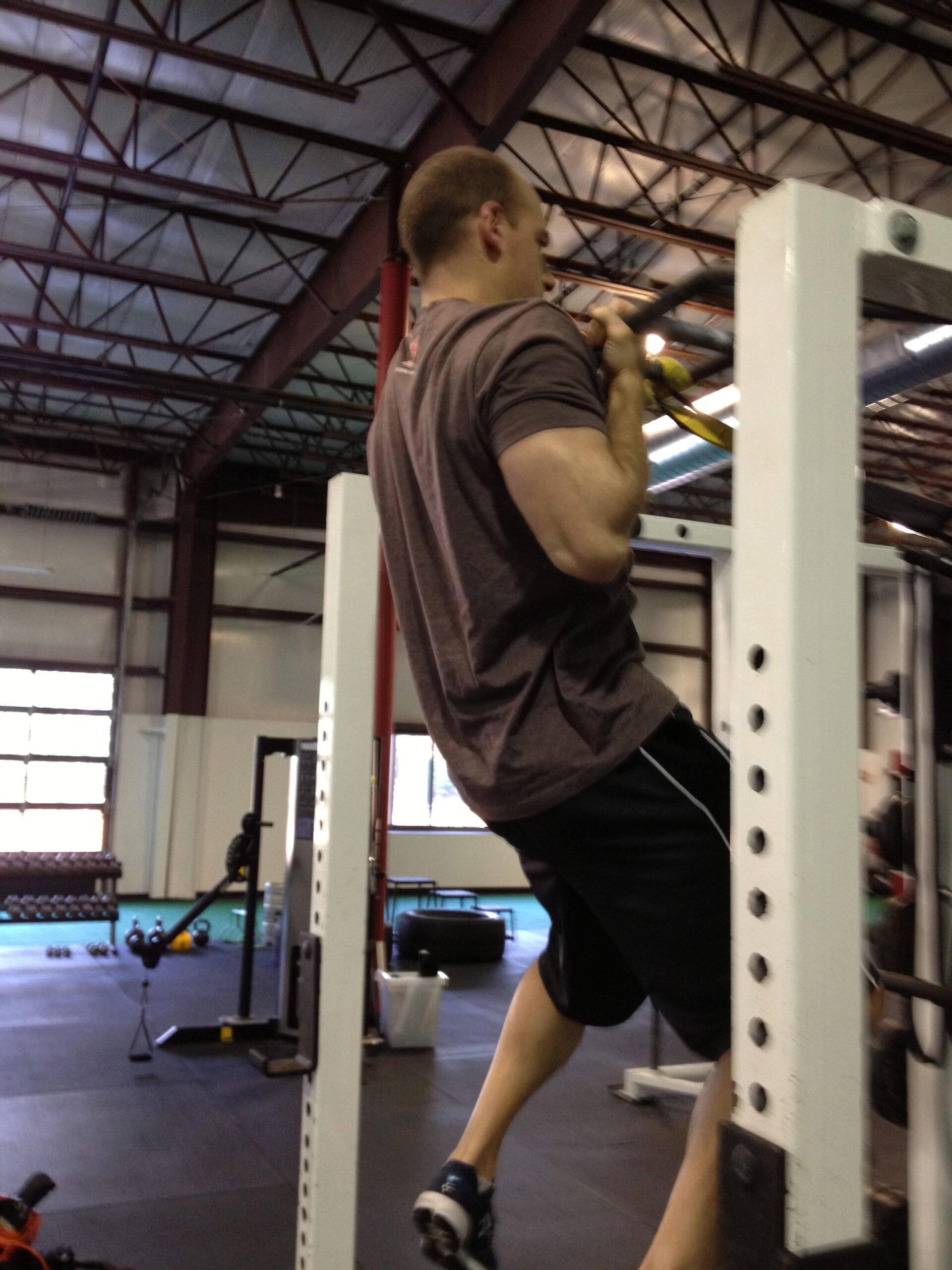
That question mark position up top which jacks up the anterior shouder seems to me to be part thoracic flexion, and part scapular retraction failure, while the lats are still going strong. Basically the lats are dominating the mid-back.
Thoughts?
-
Wow. I learn something new of your blogs almost every week. Thanks for sharing.
-
Dilan,
I’m not a fan at all. Really no incremental value, and much more risk chronically for shoulder issues.
-
Markus,
Depends on the individual. Some folks (usually external impingement cases) will have pain with overhead pulling, and others won’t. Internal impingement folks rarely have pain with these exercises, but they can indirectly feed into the dysfunction that leads to their symptoms, so you have to weigh the risks vs. benefits.
-
Penny,
It can be a good thing in those who have extension-based lower back pain. It makes it tough to load the movement up, though, as the weights slide off the waist.
-
Chris,
The scapula should be allowed to move freely; not held in retraction. However, I don’t like the idea of a dead hang in the bottom position. I’d prefer folks maintain some scapular stability in that position and not relax.
-
Derrick,
That’s basically what is going on. Lats overpower lower traps (pull scapula into depression, as opposed to the lower traps pulling the scapula into posterior tilt/retraction), and the upper traps are put at a mechanical disadvantage in the process.
-
Matt,
Good deadlifting technique can definitely be part of the process. I think appropriate carrying cues for farmer’s walks, etc. can make an even bigger difference because of time under tension, though.
-
Excellent detailed presentation, Eric.
-
Ian Condon
Brilliant, and as usual, simply told.
-
Thanks, Ian!
-
Scott
In the recap I wasn’t sure why you mentioned to not aggressively pull the shoulders down. Whats the difference between shoulders down and aggressively down? Not sure how someone would over emphasis this from a hanging position.
-
Roy Art
Material is great! I’d like to suggest for videos (and sound) to be recorded in better quality, that would be awesome
. Thanks -
Scott,
The issue is that the lats can pull the humerus into internal rotation and extension while taking the scapula into depression. This depression can be a big problem, as it interferes with adequate upward rotation of the scapula.
-
Dilan
Cheers Eric. I better stop doing them just to impress chicks
-
Coach Springs
Thank you for your information and guidance, my athletes and I will benefit from your instruction. #TeamHCT!
-
Justin Leno
As usual… amazing video! thank your very much Eric!