| As Featured In: |
|
|
Master the King of All Exercises
Deadlifting Secrets 101 Everything you need to know about this complex exercise. Free Video Training |
![]() Show and Go: High Performance Training to Look, Feel, and Move Better |
|||
Lose Fat, Gain Muscle, Increase Strength, Be More Awesome: Live Q&A #5Written on October 14, 2012 at 7:40 am, by Eric Cressey It’s time for another live Q&A here at EricCressey.com! To get your questions answered, just post your inquiry in the comments section and I’ll approve it and then reply. My only rule is that your question must be limited to five sentences or less. I’ll answer the first 25 that are posted, so please don’t bother posting questions if you come to this post days, weeks, or months after it was originally posted. With that said, head on down to the comments section below and ask away! Sign-up Today for our FREE Newsletter and receive a four-part video series on how to deadlift! 73 Responses to “Lose Fat, Gain Muscle, Increase Strength, Be More Awesome: Live Q&A #5”Leave a Reply |
|
October 14th, 2012 at 7:48 am
What do you suggest in terms of squat progressions – assuming mobility is sufficient? From beginner to intermediate, how might that go and in what approx. time-frame?
October 14th, 2012 at 7:48 am
I just had a slap repair done. is there anything specific i should be looking for in a PT?
Thanks,
David
October 14th, 2012 at 7:49 am
Is creatine a big importance to your athletes? If so when do you have them consume it?
October 14th, 2012 at 7:50 am
Hey Eric my patella tracks to the lateral side (right knee). Any tips on getting it back to neutral? Thanks
October 14th, 2012 at 7:51 am
Eric, hope all is well. Just to make sure I’m on the right track, I do still have some one-day a week clients. Usually do 3 circuits of 3(one squat dom. move, one “deadlift” move and one single leg move for lower body, etc).. Upper body is usually 2-3 pulls(trx rows, chinups, etc) and 1-2 pushes(pushups, db bench), coupled with some mobility/stretch work. Does that sound about right for a “normal” client?
October 14th, 2012 at 7:51 am
David,
Are you a thrower or a general fitness guy? In the former instance, make sure you seek out someone who has extensive experience managing overhead throwing athletes. I’ve found that a lot of general fitness PTs don’t understand the demands of overhead throwing on a number of fronts.
If you’re general fitness, I’d just make sure that you find someone with a good manual therapy background. You want someone who is willing to put his/her hands on you.
Where are you located? I might know someone near you.
October 14th, 2012 at 7:52 am
Beach Volleyball.
Sarasota FL
October 14th, 2012 at 7:52 am
When you have an athlete that is already muscular but still needs to pack on more muscle and is not a beginner in terms of training age, what do you make him do in terms of training?
October 14th, 2012 at 7:52 am
Jared,
A lot of our athletes use creatine. They usually just take it with their pre/during/post workout shake. On off-days, they may mix in it with some greek yogurt or green tea.
October 14th, 2012 at 7:53 am
Hey Eric, what do you suggest as indicated/ contraindicated as weight training for someone with a right structural scoliosis?
Thanks!
Iordan
October 14th, 2012 at 7:54 am
Mitch,
It depends; what’s the goal?
If it’s powerlifting, then you want to start with the back squat and master technique early on. Variety comes in later.
If it’s for athletics, you want to expose them to a wide variety of movements, so we’d rotate on a monthly basis – and wouldn’t even be married to the idea of them always squatting.
If it’s an overhead athlete, I’d use the giant cambered bar, front squat set-up, and safety squat bar more, but not back squat them normally.
October 14th, 2012 at 7:56 am
Can you give a general template for off season training for a young hs age pitcher? Ie How many times a week lifting, medball, etc.
October 14th, 2012 at 7:56 am
Dave,
The issue is most likely with your tracks (femur), not the train (patella). If the patella is sitting more laterally than it should, it’s because you aren’t controlling femoral internal rotation/adduction well enough. So, work on improving glute strength and motor control. Bridge variations, side-lying clams, birddogs, bowler squats, 1-leg RDLs, etc. Also, getting some soft tissue work at the hip and knee can definitely help the cause.
October 14th, 2012 at 7:56 am
Have a 16yr old baseball athlete who, despite my suggestions to his father, can only train once per week. I aim for bang for buck movements ie. med ball rotational power, deadlift, RFES, chin/push ups, chop/lifts, mobility for t-spine/hamstrings. How would you program and Convince father for more sessions in week?
October 14th, 2012 at 7:57 am
Joey – looks pretty darn solid! I tend to give out single-leg work 2-3 times a week, though.
October 14th, 2012 at 7:57 am
I’m currently weighing 65kg and have so far managed to get to 145 kg conventional deadlift for 1 repetition and same with trap bar deadlift. I tried 150 kg today but the bar wouldn’t budge.
In your experience, what are the most common muscular imbalances/weaknesses that need to be addressed when trying to increase both the lifter’s trap bar deadlift and conventional deadlift?
Thanks
October 14th, 2012 at 7:57 am
Same question that David had and I am an overhead athlete. I live in the Houston area and am considering going to DST in Houston.
Thanks,
Paul
October 14th, 2012 at 7:57 am
David – email me at ec @ ericcressey.com and I’ll get it hooked up. I have a lot of good contacts down there in the baseball world and I’ll check with them.
October 14th, 2012 at 7:59 am
1. What’s your opinion on the value of using rested HRV biometric data to moderate (or intensify) planned daily training loads in power or balanced training, as compared to its more established use in endurance sports?
2. If you could recommend one or two specific exercises for hitters to increase their hitting power, what would they be?
Thanks!
October 14th, 2012 at 7:59 am
I appreciate the answers, pardon me for not clarifying regarding the goal, I’m primarily interested in squatting to enhance general athletics.
Follow up question – you said you’d use a variety of movements – what are your favorite go-to movements?
October 14th, 2012 at 7:59 am
Danavir,
Step 1 – eat more!
Step 2 – you may need to look at the rep schemes you’re working with. A lot of guys will respond much better to lower-rep approaches as they get more experienced. It also may be appropriate to do more of a specialization program, depending on the type of athlete you’re referring to. What sport?
October 14th, 2012 at 8:00 am
Hey Eric,
If the head protrudes forward during rowing motions (despite using very light weights), what does this indicate and how to you go about fixing it?
Thanks,
Will x
October 14th, 2012 at 8:00 am
Thanks so much!
October 14th, 2012 at 8:00 am
Paul – The guys at DST do a great job. I’m sure they have some good connections for PT down there as well.
October 14th, 2012 at 8:01 am
Eric, is stretching specific muscles after they’ve been heavily worked preferable, or should some time be left for healing, or only beforehand?
October 14th, 2012 at 8:02 am
Specialization, your talking about muscle building phase or bodypart specialization? And the sport is football.
October 14th, 2012 at 8:02 am
Thoughts on oly lifting with proper form then maybe some-type of metcon for strength / power?
What do you think of cross fit?
October 14th, 2012 at 8:03 am
Hello Eric, How similarly are the demands of throwing a punch (boxer) and throwing a baseball?
Are both movement demands similar in your opinion? Would you strength train a boxer in a similar way to a pitcher? If not what differences should be considered? I know anaerobic and aerobic demands are different, but as in terms of strength training.
October 14th, 2012 at 8:03 am
Lordan,
First step is confirming that it is, in fact, a structural and not functional scoliosis. I assume you have already done that.
I think the biggest contraindication would be axial loading. Throwing load on top of a spine that doesn’t get to a true neutral is bad news. That’s not to say that you can’t handle some compressive loading; it just means that you should test the waters by loading the lower body with light weights in your hand first.
Some movements we’ve also used in the past with folks include barbell supine bridges, pull-throughs, light trap bar deadlifts, loads of dumbbell single-leg movements, 1-leg squats to bench, and sled pushing/pulling. EVERY CASE IS UNIQUE, THOUGH, SO DON’T TAKE THESE AS RECOMMENDATIONS SPECIFIC TO YOU. CHECK WITH YOUR PHYSICAL THERAPIST FIRST.
October 14th, 2012 at 8:04 am
W Shields -
Most of our high school guys do…
MoTh – lower body strength training
TuFr – upper body strength training
WeSa – movement training
Medicine ball work is 2-3 times per week before strength training or movement training.
October 14th, 2012 at 8:04 am
Hey Eric,
I was wondering when you implement manual resistance rotator cuff exercises do you replace cable external rotations etc. with them?
October 14th, 2012 at 8:05 am
David,
What is the father’s reservation about training more frequently?
October 14th, 2012 at 8:05 am
I have tennis elbow but don’t want to stop lifting. Just before it started hurting, I’d decided I wanted to start lifting heavier. Do I avoid anything that hurts at all? Or is a little discomfort ok?
October 14th, 2012 at 8:05 am
For someone with limited overhead mobility (latissimus test positive) and limited IR in both shoulder? Is trigger point work on the lats and posterior delts to downregulate their activity and then training the upwards rotators the right route to head down?
Cheers in advance
October 14th, 2012 at 8:06 am
What sort of rehabilitation might you recommend for an athlete with a desk job suffering from ‘upper-crossed syndrome’?
October 14th, 2012 at 8:06 am
Simon,
Everyone is different. Do you miss because you can’t get the bar off the floor, or because you can’t lock the weight out?
October 14th, 2012 at 8:07 am
Hi Eric, how would approach upper body training for a client that has arthritis of the ac joint?
October 14th, 2012 at 8:07 am
George,
1. I definitely think there is merit, and we’re working to incorporate more of it with our more advanced athletes.
2. Any anti-rotation core stability exercises, plus rotational med ball drills. This, of course, assumes a solid foundation of lower body power. Unfortunately, not enough hitters have that in the first place!
October 14th, 2012 at 8:07 am
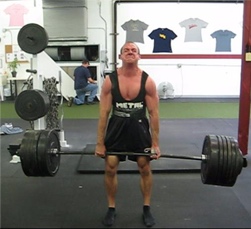
Could you analyze my deadlift? I competed yesterday and set a national Canadian record.
October 14th, 2012 at 8:08 am
Mitch,
If you want overall athleticism, rotate your movement. Use free squats, box squats, Anderson squats, jump squats, etc, etc, etc.
Stuff I really like in particular: squats vs. chains and axially loading single-leg movements.
October 14th, 2012 at 8:09 am
Phil,
Congrats on your record! Can you put video on Youtube and post?
October 14th, 2012 at 8:09 am
Hi Eric, love following you, and have learned so much. I’m in process of opening my own training facility. I have read all your articles about semi private training, which has opened my eyes. Do you have any advice for someone who is just opening their own place?
October 14th, 2012 at 8:10 am
Will,
Forward head posture is a substitution pattern for poor scapular control and faulty core stabilization patterns. My guess it that you’re dealing with someone with a big scapular downward rotation syndrome and heavy lordosis/swayback. Set the core in the right position first and go from there.
October 14th, 2012 at 8:11 am
Hi Azi,
Hope you’re well. It’s fine to stretch after strength training; I think it helps to “dissipate” eccentric stress and transition back from sympathetic to parasympathetic function. I like dynamic stretching beforehand. If someone is very tight, though, static stretching pre-training is fine.
October 14th, 2012 at 8:13 am
Danavir,
Meant bodypart specialization, but that wouldn’t apply to football players. Was thinking more of powerlifters or bodybuilders in that context.
Biggest thing football guys can do is not waste away during the season. Keep weight up and maintain strength as much as possible. It makes progression easier if you never take a step back!
October 14th, 2012 at 8:14 am
Chad,
1. Think it’s totally fine. You won’t build strength/power with metabolic conditioning though. That’ll build some strength endurance.
2. Give this a read: http://www.ericcressey.com/crossfit-for-baseball
October 14th, 2012 at 8:16 am
Hi Eric, what recommendations would give to someone that lacks the upper body mobility to back squat (misses neutral spine because of lack of shoulder external rotation), but wants to eventually be able to do so.
Thanks.
October 14th, 2012 at 8:16 am
Said,
Similar at deceleration; both have aggressive internal rotation and horizontal adduction. Throwing has more pronation to protect the shoulder, though, and a long deceleration arc.
Totally different at cocking, though. Lay-back during throwing is the most injurious part of the motion, and you don’t get that during punching. So…
Boxing more injurious at deceleration (especially if you break your hand on some guy’s face).
Pitching more injurious at cocking.
October 14th, 2012 at 8:16 am
Taylor,
Yes.
October 14th, 2012 at 8:17 am
Thanks for your reply. It’s getting the bar off the floor that i fail at.
October 14th, 2012 at 8:17 am
Lori,
I wouldn’t push through any discomfort. Have you gotten soft tissue work? Tried a tennis elbow sleeve?
Give this a read and check out the comments section, too: http://www.ericcressey.com/understanding-elbow-pain-part-5-the-truth-about-tennis-elbow
October 14th, 2012 at 8:17 am
Thanks for reply re template.
One more question. I work with a 13 yr old athlete(about average in physical maturity for age) and wonder how hard to push deadlifts at his age. I have read about issues with immature spines being susceptible to injury. I have stayed with hex deadlifts to lessen chance of injury.
October 14th, 2012 at 8:18 am
Cool!One one question if there is time, rotational power… other than the med ball rotational throw, what else do you use? This is for my MMA fighters
October 14th, 2012 at 8:18 am
Neal,
That’s a great start. You also need to work on improving t-spine mobility, improving length of long head of the triceps, and enhancing anterior core stability.
October 14th, 2012 at 8:18 am
Eric,
Thinking along the lines of the 23/1 rule, what are your recommendations with mobility work outside the gym?
thanks
October 14th, 2012 at 8:18 am
Hello, First of all I would like to thank you for what you do for the strength and conditioning field. My question relates to programming for an imbalance. For example, following an assessment you determine that horizontal pulling strength is much less than horizontal pushing and you have the “typical” associated postural flaws, how would you allocate your loading parameters?
October 14th, 2012 at 8:20 am
Spencer,
Step 1 is getting up from that desk job more often! You can do everything correctly while you’re training/rehabbing, but if you feed right back into the dysfunction for 8-10 hrs/day, you won’t get anywhere. So, look at postural and/or ergonomic adjustments first.
Have you checked out Assess and Correct yet? Great resource on this front: http://www.assessandcorrect.com
October 14th, 2012 at 8:21 am
Eric,i have l4-l5 and l5-s1 disc hermiations. What do you recommend for strengthening my core? I have been lifting for over 15 years and am all natural. Thank you sir!
October 14th, 2012 at 8:22 am
Bradford,
That’s an incredibly common finding. Everyone should be managed differently, though. Assess how the client moves, then determine a corrective course of action that doesn’t exacerbate the issue. I’m sure you’ll find that end-range overhead reaching, horizontal adduction, full extension, and direct pressure give the most pain. Give these a read:
http://www.ericcressey.com/newsletter168html
http://www.ericcressey.com/newsletter169html
October 14th, 2012 at 8:25 am
Craig,
Absolutely! Have written a lot about it on here, but top thing that stands out in my mind is to never let your business model dictate your training model. The training should dictate the business model, as the goal is to get the best results you can and provide the best service possible.
Have you checked out The Fitness Business Blueprint? It would be hugely valuable for you as a start-up and save you a lot of $$ in mistakes.
October 14th, 2012 at 8:27 am
Alonso,
Give this a read:
http://www.ericcressey.com/newsletter144html
Also, add a lot of these in:
http://www.youtube.com/watch?v=eLWiFbPN-2U
October 14th, 2012 at 8:27 am
Simon,
In that case, start with working on your bar speed. You’re just not putting enough force into the ground quickly enough to break the floor. I’d do a lot of speed pulls for 1-3 reps in the 55-80% of 1RM range.
October 14th, 2012 at 8:28 am
W Shields – no need to push loading too much at that age. He will still get stronger, but stay conservative. We usually don’t do any axial loading on squats with our kids under 15. Trap/hex bar is a good bet for now.
October 14th, 2012 at 8:29 am
I like heiden (skater) jumps. Example: http://www.youtube.com/watch?v=cS_JHyb-W_E
October 14th, 2012 at 8:30 am
Hi Andrew,
I like to see folks who really need it working it in to their daily routines as much as possible – even if it’s just doing 1-2 sets in the middle of a work day. I’ll often have folks work on foam rolling, mobility work, or static stretching at night while they’re watching TV, too.
October 14th, 2012 at 8:30 am
Harland,
Give this a watch: http://www.youtube.com/watch?v=pxbmcPzMKkI
October 14th, 2012 at 8:32 am
Trey,
It’s impossible to make individualized recommendations for you, but I’d say the following:
1. 38% of ASYMPTOMATIC Americans have the same diagnoses as you do. Give this a read: http://www.nejm.org/doi/full/10.1056/NEJM199407143310201
2. Check with a physical therapist to determine what your movement flaws are.
3. Remember that core stability encompasses a number of things:
http://www.ericcressey.com/core-stability-exercises-strength-and-conditioning-programs-1
http://www.ericcressey.com/core-stability-exercises-strength-and-conditioning-programs-2
October 14th, 2012 at 8:33 am
That wraps it up for today, folks; thanks for all the great questions! We’ll do this again soon.
Best,
Eric
October 14th, 2012 at 8:37 am
This is the link on youtube:
http://www.youtube.com/watch?v=Fij5Pn0LlqA&feature=youtu.be
Thanks Eric!
Phil
October 14th, 2012 at 9:46 am
Phil,
Mostly just looks slow off the floor. How much speed pulling do you do? Might benefit you to do more fast singles in the 65-80% range. Other than that, pretty solid.
October 14th, 2012 at 11:05 am
I do virtually no speed work. I deadlift heavy, usually a 2×5, once every two weeks. Would including it on the weeks I don’t go heavy work?
October 14th, 2012 at 1:31 pm
Phil,
You need to pull more often. I did it twice weekly when I made my biggest strides. Once for speed, once heavier.
October 14th, 2012 at 10:32 pm
Speed work is an incredible way to burn fat and work your fast twitch muscle fibers. I Have noticed a huge difference in my body fat and strength since incorporating sprints into my routine.