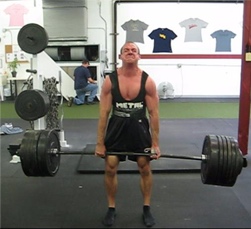
Compliments of Cressey Performance coach Greg Robins, here is this week's list of quick and easy ways to feel and move better.
1. Get on the same page with other coaches in your facility.
In the past six years, I have split the vast majority of my coaching among three different facilities. Therefore, I can speak with certainty on the how important it is to have universal coaching cues. Every coach has a unique coaching style that gives clients and athletes a new perspective; this style should be nurtured and not destroyed. However, putting universal coaching cues in place doesn't have to come at the expense of their "style." If you are the owner of a facility, make sure to outline some general cues for the staff to use. It will also help to get coaches working together on "tougher" cases where the first set of cues may not elicit the desired response. This extra collaboration will help you teach more efficiently, and you'll have fewer confused athletes and clients: both good things!
2. Stop blaming the program.
I see it all the time, and apparently it's human nature? Instead of looking at the reasons one might be letting oneself down, it's easier to instantly look to find errors in their "program." The truth is that nobody has any business scrutinizing anything but themselves until they are doing these things CONSISTENTLY: showing up, sleeping enough, eating appropriately, and putting in sufficient effort. If you do all four of those day in and day out, then we're off to a good start. However, it's still not the program's fault. As examples, here are two other common reasons you aren't allowing your strength and conditioning program to work for you. One, you miss reps and get too impatient choosing weights. If you continue to miss lifts, you'll continue to make no progress. Two, you take too long to train. Don't blame the workouts for not helping you lose body fat. They hardly become workouts when you take two hours to mosey through them.
Make the little things a habit, check your ego, train with a purpose, and good things will happen. It's not the program's fault!
3. Consider skipping breakfast...seriously!
Breakfast has been revered for years as the most important meal of the day. After all, in order to get the day started off right, you need to get breakfast, right? However, what if getting breakfast "right" meant not eating breakfast at all?
If we look to some of today's most popular nutrition schemes, we can find a few similarities. For example, intermittent fasting (IF) and carb back loading disciples both pass on the morning chow. Furthermore, the idea of consuming carbohydrates in the morning is slowly becoming a thing of the past. The research is pretty interesting, and so are the results and conclusions of these nutritional gurus.
The basic premise is that upon waking our hormone levels are raised in such a manner that we are in a near ideal state to use fat for energy. Consuming food, and especially the typical morning carbohydrate varieties, will actually alter the hormone levels and put us in a far less ideal scenario to promote fat loss, and muscle building throughout the day.
After reviewing the work of John Kiefer and the various sources on IF, I began waiting on breakfast until a few hours after waking. Even then, I limit my calories substantially until mid afternoon, with the bulk of them coming in the evening. It may seem backwards from the typical beliefs, but I have seen great improvements in energy, body composition, and strength gains. What are your thoughts? I'd love to hear them!
4. Match your set-up to your body for bigger lifts.
Here is one you can apply right away. In the past I would choose my stance and hand-widths based on what I saw other successful people doing. A lot of the big squatters were wide, so I would put my feet nice and wide.
Then, I started to video more of my training. I looked at how my body reacted to the loads, especially lifts up over 90%. What I realized was that certain reactions from my body weren't so much a result of the weight being too heavy, or a lack of cueing, but the way I set up.
I decided to work with how I was built. My back was wide, so I moved my hands out on the bench press, and my feet to match; the bench numbers took off. My hips are pretty narrow, so I moved my squat stance in; it helped me to stay in better control, and I began to handle heavier weights much more confidently. Luckily for me, my deadlift stance was already narrow, but that would explain why for years it was the only respectable lift I had.
When you set up, take how you're built into account, rather than relying on just what you have seen work for others. As a coach, do the same with your athletes and clients. Look at how they are put together and choose stances, and even exercise choices, that make sense for their body. Several years ago, Eric and Mike Robertson had a multi-part series that touched on this: Overcoming Lousy Leverages Part 1and Part 2. I'd encourage you to check them out.
5. Stop using weighted bats and donuts to warm up.
To touch upon something more baseball specific, a recent study performed in Kanoya, Japan at the National Institute of Fitness and Sports, found that performing a warm up with a weighted bat had adverse effects acutely on timing for hitters. This is something that has shown to be true a few times, and it makes perfect sense.
In a similar fashion to other sport specific overloaded exercises, it can be detrimental to add weight to a movement too specific to the actual sport movement. For example, overloading sprint mechanics too heavily (via sleds, or resistance bands) has been shown to negatively affect the sprint mechanics of athletes.
Instead, consider using your time in the on deck circle more intelligently. Study the pitcher's mechanics to help time your approach. Additionally, try and locate his release point so that you can get eyes on the ball earlier come your at bat. For strength coaches, let this be another example of how overloading the mechanics of an actual sport skill can ruin the mechanics at game speed.
All this said, there may be merit to adjusting bat load in terms of chronic adaptations; just don't do it right before you step up to the plate.
Sign-up Today for our FREE Newsletter and receive a four-part video series on how to deadlift!
Just over three years ago, during a period where oblique strains were on the rise in professional baseball and the USA Today profiled this "new" injury, I wrote an article on what I perceived to be the causes of the issue. Check it out: Oblique Strains and Rotational Power.
This year, the topic has come back to the forefront, as players like Joba Chamberlain, Sergio Mitre, Curtis Granderson, and Brian Wilson have experienced the injury this spring training alone.
While my thoughts from the initial article are still very much applicable, I do have some additional thoughts on the matter for 2011:
1.Is anyone surprised that the rise in oblique injuries in baseball is paralleled by the exponential rise in hip injuries and lower back pain? I don't care whether you work in a factory or play a professional sport; violent, repetitive, and persistently unilateral-dominant rotation (especially if it is uncontrolled) will eventually chew up a hip, low back, or oblique; it's just a matter of where people break down.
In other words, pro athletes are generating a tremendous amount of power from the hips - moreso, in fact, than they ever have before thanks to the advances in strength training, nutrition, supplementation, and, unfortunately, in some cases, illegal "pharmaceutical interventions." Assuming mechanics are relative good (as they should be in a professional athlete), rotate a hip faster and you'll improve bat speed and throwing velocity; it's that simple. This force production alone is enough to chew up a labrum, irritate a hip capsule, and deliver enough localized eccentric stress to cause a loss in range of motion. The Cliff's Notes version is that we've increased hip strength and power (more on this in a bit), but most folks have overlooked tissue quality (foam rolling, massage, and more focal approaches like Active Release and Graston) and mobility training.
If the hips stiffen up, the lumbar spine will move excessively in all planes of motion - and, in turn, affect the positioning of the thoracic spine. Throw off the thoracic spine, and you'll negatively impact scapular (and shoulder), respiratory (via the rib cage), and cervical spine. Hips that are strong - but have short or stiff musculature can throw off the whole shebang.
2. "Strong" isn't a detailed enough description. I think that it goes beyond that, as you have to consider that a big part of this is a discrepancy between concentric and eccentric strength. Concentrically, you have the trailing leg hip generating tremendous rotational power, and eccentrically, you have the lead leg musculature decelerating that rotation.
Moreover, because the front hip can't be expected to dissipate all that rotational velocity - and because the thoracic spine is rotating from the drive of the upper extremities - you put the muscles acting at the lumbar spine in a situation where they must provide incredible stiffness to resist rotation. It is essentially the opposite of being between a rock and a hard place; they are the rock between two moving parts. Structurally, though, they're well equipped to handle this responsibility; just look at how the line of pull of each of these muscles (as well as the tendinous inscriptions of the rectus abdominus) runs horizontally to resist rotation. That's eccentric control.
How do we train it? Definitely not with sit-ups, crunches, or sidebends. The former are too sagittal plane oriented and not particularly functional at all. The latter really doesn't reflect the stability-oriented nature of our "core." The bulk of our oblique strain prevention core training program should be movements that resist rotation:
While on the topic, it's also important to resist lumbar hypextension, as poor anterior core strength can allow the rib cage to flare up (increases the stretch on the most commonly injured area of the obliques: at the attachment to the 11th rib on the non-throwing side) and even interfere with ideal respiratory function (the diaphragm can't take on its optimal dome shape, so we overuse accessory breathing muscles like pec minor, sternocleidomastoid, scalenes, etc).
So, to recap: I don't think oblique strains are a new injury epidemic or the result of team doctors just getting better with diagnostics. Rather, I think that we're talking about a movement dysfunction that has been prevalent for quite some time - but we just happen to have had several of them in a short amount of time that has made the media more alert to the issue. The truth is that if we worried more about "inefficiency" and not pathology," journalists could have "broken" this story a long time ago.
Sign-up Today for our FREE Baseball Newsletter and Receive a Copy of the Exact Stretches used by Cressey Performance Pitchers after they Throw!
1. I started this week off with a bang with a few good (and goofy) YouTube clips in my newsletter, so there's no reason to shy away from a continuation of the awesomeness in this blog.
2. Tony Gentilcore got the day off from work today. He claimed it was to go see the filming of the next Functional Strength Coach seminar, but we all know it was just a front for his regular ol' "weird ninja dude in the woods" routine. Glad you enjoyed your alone time, big guy.
2. Congratulations to CP athlete and New York Mets minor leaguer Tim Stronach (St. Lucie Mets: High A), who just missed both a perfect game and no-hitter on Wednesday. "Stro" took a perfect game into the 8th inning, and then lost the no-no with one out in the 9th. The wildest part is that Tim didn't even know until the day before that he'd be making the start.
Stronach packed 21 pounds on his 6-5 frame this off-season with loads of hard work at Cressey Performance, and deserves all the success that comes his way. Great job, Tim!
3. I received an email with the following question yesterday: "I play basketball. I watch how guys lose lots of weight and bodyfat preparing for the combine. How do they do that?"
Answer: The overwhelming majority of college basketball players I've encountered live on sugary sports drinks, chicken wings, pizza, and booze. Simply cleaning up their diets for a month or two will work wonders even if training is held constant. Did you expect something more revolutionary?
4. Here's another study showing that swinging a heavy bat prior to regular hitting is an inferior warm-up protocol as compared to swinging the normal bat or an underweighted bat. Researchers "suggested that when preparing to hit, 5 warm-up swings with either a light or normal bat will allow a player to achieve the greatest velocity of their normal bat." This is in complete contrast to the use of weighted baseballs to increase throwing velocity; I love 'em when used with the right population.
5. Huh? What? Come again?
6. I went back through Jim Smith's Accelerated Muscular Development today to check up on how he approaches formatting for e-books (as we prepare some for the upcoming project's release). While I was looking it over, I got to thinking about how it never ceases to amaze me how thorough Smitty is with his products; he just seems to cover everything. I've said it before: this is a great resource; I'd highly recommend you check it out.
In last week's newsletter, I observed that there are a lot of folks out there who think that weight training is unnecessary and plyometrics are sufficient for injury prevention and performance enhancement in pitchers. While a system like this might hold some merit in a population such as football where many athletes already have a large strength foundation, it doesn't work as well in a baseball population, which doesn't have that same foundation.
To illustrate my point, I'm going to touch on a concept - static-spring proficiency - that I covered at length in my Ultimate Off-Season Training Manual. Essentially, you have "static" athletes, "spring" athletes, and everything in between the two. You can use a series of performance tests and evaluate an athlete's training history to get an appreciation for where each athlete falls on this continuum.
"Static" athletes tend to have a good strength foundation - so much, in fact, that they tend to "muscle" everything. In other words, there is less efficient use of the stretch-shortening cycle to produce force. An example might be a powerlifter attempting to go out and play basketball. In order to improve, a "static" athlete needs to focus on improving reactive ability.
"Spring" athletes are great at using stored elastic energy in tendons to produce power. An example would be a basketball or volleyball player who has been jumping for years and years to develop spring, but without much attention to building the underlying strength needed to best use it. So, obviously, to improve, these athletes need to enhance muscular strength while maintaining their great elastic qualities.
Here's an excerpt from my Off-Season Manual that personifies this in the world of baseball:
"The modern era of baseball is a great example, as we've had several homerun hitters who have all been successful - albeit by very different means.
"At the 'spring' end of the continuum, we have hitters like Gary Sheffield and Vladimir Guerrero demonstrating incredible bat speed. The ball absolutely rockets off their bats; they aren't 'muscling' their homeruns at all. Doing a lot of extra training for bat speed would be overkill for these guys; they'll improve their power numbers by increasing maximal strength alone.
"At the other end of the spectrum, we have 'static' homerun hitters like Mark McGwire and Jeff Bagwell, both of whom were well known for taking weight training very seriously. These guys are the ones 'muscling' baseballs out of the ballpark; the ball almost seems to sit on the barrel of the bat for a split-second before they "flip it" 500 feet. Getting stronger might help these guys a bit, but getting more spring by focusing on bat speed with reactive training (e.g., plyometrics, sprinting, medicine ball throws, ballistic push-ups, etc.) would be a more sure-fire means to improvement.
"Then, we have the 'middle-of-the-road' guys like Barry Bonds and Manny Ramirez. They possess an excellent blend of static and spring, so they need to train some of both to continue improving physically.
"Bonds is actually a good example of how an athlete's position on the static-spring continuum can change over the course of a career. When he started out, he was definitely a 'spring' guy, hitting most of his homeruns with pure bat speed. As Bonds' career progressed, his maximal strength improved due to neural adaptations and increased cross sectional area (more muscle mass).
"In light of the media attention surrounding the use of performance-enhancing substances in baseball, I should mention how he increased his muscle mass isn't the issue in question in the discussion at hand. The point is that he did increase muscle mass, which increased maximal strength, which favorably affected performance. The performance enhancing substances question really isn't of concern to this discussion."
Now, here's where it gets interesting - and where you get a bit more time to think about this.
Obviously, even to the most casual observer, not all baseball players are like Manny Ramirez, Barry Bonds, Mark McGwire, Jeff Bagwell, Gary Sheffield, and Vladimir Guerrero. This isn't rocket science; they are/were a heck of a lot more skilled and experienced than the overwhelming majority of the professional baseball world, and certainly all of the amateur ranks.
How are they different? And, why can't we just assume what might work for some of them will work for those aiming to reach the levels they've attained?
Well, you'll just have to think about that until Newsletter 141...
New Blog ContentRandom Friday ThoughtsSunday ThoughtsPush-ups for Baseball PlayersStuff You Should Read
All the Best,
EC
Sign-up Today for our FREE Baseball Newsletter and Receive a Copy of the Exact Stretches
used by Cressey Performance Pitchers after they Throw!