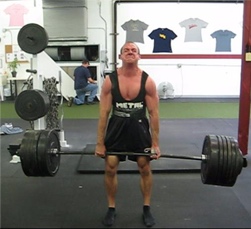
Happy Memorial Day! Thanks to all those present and past who have served to protect our freedoms.
Here's some recommended reading to check out once all the barbecues and family time have settled down later today.
44 Lessons I've Learned Along the Way - If you're involved in the fitness business (or any business) and haven't seen one of Pat Rigsby's epic lists, you're missing out!
What You Should Know About Sleep - Chad Waterbury doesn't post often, but when it does, it's always a good read. Check out this article about sleep quantity and benefits.
I'm in Chicago to speak at the Perform Better Summit this weekend, but fortunately, my good friend Chad Waterbury provided this guest post for today. Enjoy! -EC
In 2001, I went with a buddy to Vegas. I wish I could say the trip was replete with all the temptations that Sin City had to offer, but it was strictly business.
At the time, I had a packed personal training calendar that kept me busy from dawn to dusk. Most of my clients were guys that wanted to build muscle, so I had them do a combination of heavy and high-rep training to failure.
That’s how bodybuilding protocols worked back then, and most of them still do today. I made my clients work hard and they trained each major muscle group about twice per week.
Now this is where my Vegas trip comes in.
That year I went to see the Cirque du Soleil show, Mystere. Many of my clients had seen the popular show and they mentioned that I should make a point to attend, mainly because of two heavily-muscled gymnastics that display mind-blowing feats of strength: the Alexis Brothers.
As my brain assimilated what I was seeing. I remember feeling blown away. What astonished me most weren’t the incredible routines they did, even though they were the coolest and most impressive things I’d ever seen.
Nope, I was absolutely shocked by the frequency they had to perform that routine. These guys were doing 10 shows per week!
What the Alexis brothers were doing defied all the “laws” of training and recovery I’d been taught in college, textbooks, and online write-ups. That moment I had an epiphany, if you will: I was going to have my clients train their underdeveloped muscles with a higher frequency. I was determined to figure out just how often a person with average genetics could stimulate a muscle group and still recover.
Eleven years later, in 2012, I had accumulated a huge amount of data on frequent training that I was ready to share. So, I released my High Frequency Training (HFT) training system to teach my audience how to build muscle using this approach.
My approach for HFT was pretty simple. First, you would choose an exercise you could do for anywhere from 12-20 reps before failure. Then you would perform a target number of total reps each day, say, 50. Finally, you would add a rep each day over the course of a few months.
It was a very good system, especially with exercises such as the pull-up, and many people gained a lot of muscle from it.
However, I still felt I could make HFT better. So over the last two years I continued to experiment with different training protocols while taking in the feedback from those who were following HFT.
What did I learn? A whole lot. Now my frequent training plans are shorter, and more specialized for each major muscle group. There are three components for making a frequent training plan work for you.
1. Understand whether a muscle responds best to high or low reps: The biceps won’t grow with high rep training; if they did, collegiate rowers would have massive guns. The quadriceps, however, will definitely grow with high reps – just ask any cyclist.
2. Stimulate the muscle group as quickly as possible: When you start working a muscle more often the last thing you want to do is spend more time in the gym. Plus, if the extra workouts are too long you’ll burn out fast. You must stimulate that muscle as quickly as possible, and it doesn’t take long if you know what to do.
Here’s one example for the pecs:
Push-up Iso-Squeeze: Get in the top position of a push-up, then attempt to pull your hands together as intensely as possible for 10 seconds (any longer than that and you won’t be recruiting the largest motor units).
Do 5 sets of that iso-squeeze with two minutes rest between sets every other day. It works!
3. Spare the joints: All forms of exercise stress the joints, but some do more than others. If you start doing an overhead triceps extension or leg curl every day, you’ll run into joint problems in a hurry. That’s why my latest muscle-building system, HFT2, incorporates instructional videos so you can learn how to best spare the joints and target the muscles.
As an example. Here’s how I spare the knees for the Goblet Squat:
Keep these three points in mind as you train with a higher frequency and you’ll get much better results.
Note from EC: we've already started experimenting with some of Chad's ideas on the high frequency training front, and I think it has tremendous merit. If you're looking for some direction to take the guesswork out of these applications, I'd encourage you to check out Chad's new resource,High Frequency Training 2, which is on sale through Tuesday at midnight.
Sign-up Today for our FREE Newsletter and receive a four-part video series on how to deadlift!
This Saturday, Chad Waterbury will deliver his Advanced Training Workshop at Cressey Performance. And, since I hadn't caught up with him here for quite some time, I thought it'd be a good time to bring him back for an interview. Check it out. -EC
EC: Welcome back to EricCressey.com! It's been a while since we last touched base, so we ought to get up to speed on what you've been doing. To start, what would you say is the biggest change you’ve made compared to when you started training?
CW: The most significant change I’ve made is the way I assess clients. In the early days I would do some basic range of motion tests and ask a client which joints felt stiff or painful. Then I would do a combination of soft tissue work and PNF stretches to correct the issues. It helped clients move better and have less pain for the workout that followed, but those were usually just temporary changes. The next workout the client would often complain of the same problems.
Take the IT band, for example, since it’s usually stiff and painful to the touch on many athletes. I used to have my clients foam roll the IT band before training to release the tension. It hurts like hell to foam roll a super stiff IT band, and it’s easy to associate the pain of foam rolling with a gain in tissue quality. But that’s rarely the solution. In most cases, the IT band would be right back where it started the following day.
So a few years ago I started studying more progressive corrective approaches, namely the Postural Restoration Institute (PRI) and Dynamic Neuromuscular Stabilization (DNS). What I learned from those two approaches is how imperative it is to identify and correct the position of the ribcage and pelvis.
In my early training years I would look for muscles that were tight or painful and find a way to eliminate the tension through stretching or foam rolling. But I learned that instead of figuring out how to release a tight muscle it’s much more valuable to ask yourself: Why is the muscle tight?
When you learn to ask the right questions you put yourself much closer to the solution.
EC: I agree. Learning and integrating PRI into our system has been a huge game changer, and you'll definitely see aspects of DNS in our training programs, too.Where are you seeing it have the most dramatic impact?
CW: Three areas that often have excessive tension are the psoas, TFL and IT band. Now, you can stretch and foam roll and it might help temporarily. But in many cases the psoas is excessively stiff because the diaphragm and ribcage aren’t sitting properly. For the TFL and IT band, those problems are usually related to a rotated pelvis and poor glute activation. When you correct those issues, and sometimes it only takes five minutes, the excess tension disappears immediately. Now you’re working on the source of the problem.
Or take shoulder pain as another example since that’s one area you specialize in. I think we have learned how crucial proper positioning of the ribcage and diaphragm are for optimal shoulder mechanics.
And the coolest part is that it’s not difficult to learn how to reposition the ribcage or pelvis, once you know what you’re looking for.
EC: I read your blog post where you describe some of the things you learned at the Movement Performance Institute. Care to elaborate on that?
CW: I think it’s the duty of a trainer or therapist to make an effort to learn from others. The key is to seek out experts that have had considerable success in a specific area and do your best to learn from them. That’s what I try to do.
I had heard some terrific things about the research from Chris Powers, Ph.D., at his Movement Performance Institute in west Los Angeles. So I met with him last fall and he let me spend five months under his tutelage where I drastically increased my training IQ, especially when it comes to the biomechanics of running and glute development.
Dr. Powers wears many hats. He’s a professor at the University of Southern California (USC), a physical therapist, and one of the world’s best researchers on knee rehab, especially ACL injuries. He was one of the first researchers to demonstrate that patients who have knee pain probably have weakness in the hips and core.
What’s also great about Dr. Powers is that he has a background in powerlifting. He isn’t a guy who wants you to spend the rest of your training days doing band exercises. His goal is to get you back to lifting hard and heavy. That was one of the things about him that impressed me most, and why I wanted to learn from him.
Now my approach to glute training, and how I implement it to increase performance, is at a much higher level. I learned why many of the glute exercises out there are doing very little to reduce knee pain or increase athleticism. The glute max, in particular, is a tri-planar muscle group so you must train it with that fact in mind.
EC: It sounds like you’ve shifted more toward the physical therapy end of the spectrum, as opposed to traditional performance training?
CW: When it comes to building explosive strength the key is to figure out where an athlete is weak or compensating. Once you correct those issues, explosiveness will increase tremendously. It doesn’t matter if you’re a powerlifting coach, an athletic trainer or a physical therapist, the goal is always the same: find where the athlete is weak and fix it. In other words, if you want to be a guy who builds explosive strength you must be proficient at identifying and correcting the factors that affect it.
I’m learning how important those factors are thanks to my time working with incredible doctors like Chris Powers, Stu McGill and Craig Liebenson. I’ve become passionate about the clinical side of athletic development. That’s why I’m heading to USC in the fall to start their doctor of physical therapy program.
EC: How do you typically assess clients?
CW: Everything starts with the ribcage and pelvis. The reason is because those two areas have such far-reaching effects. The feet are also important to assess. Most people shouldn’t train barefoot because they have excessive pronation that, in turn, can cause knee valgus. And if there’s one thing you need to stay away from, it’s knee valgus. You only need to read the research by Chris Powers, PhD, and Tim Hewett, PhD, for proof.
What I do next depends on the type of client I have. If it’s an athlete, I’ll test the vertical jump, deadlift and 5-10-5, for starters. Those are three key indicators when improvements in explosive strength and agility are the goal.
However, as I said in the beginning, the assessment is the most crucial part of any training program because it will identify where you need to focus your time and energy. My goal is to use the fewest corrective exercises possible. And, sometimes the best corrective is to just use better form while lifting.
EC: Great stuff, Chad. Thanks for the interview!
For those interested in this weekend's workshop, we still have a few spaces open. You can register HERE.
And, if you can't make the workshop, you can still visit Chad's site at www.ChadWaterbury.com.
Last week, I got an email from Chad Waterbury saying that after years of trying to make it work, he was finally flying out to the East Coast to hang out with us at Cressey Performance. Since Chad doesn't get to this side of the country very often, I floated the idea of doing a workshop while he's here, and he was all in! It's short notice, but this April 5 from 2pm to 6pm, he'll deliver his Advanced Training Workshop at CP in Hudson, MA - and we'd love to see you there!
Here's some of what Chad will cover:
The essential factors that limit and enhance explosive power.
The crucial role of proper ribcage and pelvis alignment, and how to identify and correct them.
How to increase full-body neural drive before each training session using only your body weight.
A simple way to get the most glute activation during squats and deadlifts. (Hint: it’s not the “spread the floor with your feet” trick.)
The single most accurate test to determine if your client is at risk for knee injury.
The most effective ways to measure explosive strength.
Key elements for designing any strength-building program.
In short, these four hours will be jam-packed with knowledge you'll be able to put into action immediately. Here are the specifics:
Date/Time: Saturday, April 5, 2014, 2pm-6pm
Location: Cressey Performance, 577 Main St - Suite 310, Hudson, MA.
Price: $99.99 regular, $79.99 student rate through the early bird registration deadline (March 31). The price goes up $30 after 3/31.
If you'd like to register more than one attendee, please just change the quantity to 2 (or more) on the order form, and then list the attendees' names and email addresses in the comments section.
Sorry for the short notice, but this opportunity is too good to pass up, as Chad is fantastic in seminar. Hope to see you there!
For those interested in hotel options, we have a great deal in place with Extended Stay America - Marlborough. They offer a preferred rate of $59.00 + tax on Queen Studio Suites. Rates can be accessed by calling the hotel at 508-490-9911 and identifying yourself as a guest of Cressey Performance.
Sign-up Today for our FREE Newsletter and receive a four-part video series on how to deadlift!
To wrap up my "Best of 2012" series, I'll highlight the top product reviews I did at this site in the last year.
1. Deadlift Dynamite - This product was a great fit for me to review not only because I'm particularly fond of picking heavy s**t up off the floor, but because Andy Bolton and Pavel Tsatsouline packed so much practical, yet forward-thinking information into it that it was hard to not rave about it! Check out my entire review: What a 1,000-Pound Deadlift Can Teach You.
There were certainly some other great products I encountered this year, but these three reviews proved to be the most popular with my readers, based on hosting statistics.
2. High Frequency Training - I'd actually say that this was my "funnest" read among the product reviews featured here, as I've always enjoyed Chad Waterbury's writing and perspective. It'll really make you rethink your perspective on volume management in training programs - and if you're looking for a program to kick your butt, look no further.
3. Elite Training Mentorship - It probably sounds incredibly self-serving to review my own product, but Elite Training Mentorship is a resource of which I'm tremendously proud because it isn't just mine. Rather, it's updated monthly with contributions from great coaches like Mike Robertson, Dave Schmitz, Tyler English, Vaughn Bethell, Steve Long, and Jared Woolever. With monthly updates - in-services, exercise demonstrations, webinars, articles, sample programs - from each of us, this is a fantastic continuing education resource that is both affordable and convenient. This isn't so much a product review, but I think you'll appreciate how this article demonstrates just how valuable a site like this is: 5 Reasons to Be Excited About the Future of the Fitness Industry.
There were certainly some other great products I encountered this year, but these three proved to be the most popular with my readers, based on hosting statistics. Hopefully, there will be plenty more to come in 2013!
Sign-up Today for our FREE Newsletter and receive a four-part video series on how to deadlift!
I was fortunate to receive an advanced copy of Chad Waterbury's newest project, High Frequency Training, earlier this week, so I thought I'd do a quick write-up on the product.
One of the things I've always admired about Chad is his extensive educational background; all of his programs are based on theories that are heavily rooted in both his research and anecdotal observations. It takes a lot of time to learn scientific principles, apply them in the real world and evaluate results, then "re-program" in consideration of what did and didn't work. Chad is one of the few people in the industry with the unique background and experience to have accomplished this, and High Frequency Training is an outstanding example of his efforts. There are a lot of books out there that were published by schmucks with absolutely no frame of reference; this isn't one of them.
I also think Chad does a tremendous job of relating complex topics in the conversational and easy-to-understand format. Truthfully, I often glaze over the "rationale" portions of the books I encounter - either because I already understand them, or because it's so poorly written that I'd rather just get to the meat and potatoes (the program). Conversely, Chad's discussion of how he came to understand the how various loading protocols impact the overall volume equation was outstanding. In short, if you want big muscles, you have to be exposed to a high training volume - but that may come from a variety of set/rep/load combinations.
One can't just haphazardly add volume, though, as overuse injuries can easily kick in if you just keep adding and adding. Additionally, you can't simply add volume in all aspects of your program; you have to pick and choose the appropriate times and places so that you're making progress instead of just treading water. Chad's program takes the guesswork out of adding volume. And, as an added benefit, you'll likely get a bit leaner from the increased exercise volume and frequency.
Perhaps the greatest compliment I can pay to this program, though, is that it's making me revisit how I am planning my own training. Admittedly, I've trended toward much lower volume strength training programs as I've gotten older and the rest of the stress in my life has increased. After reading through this e-book, I'm searching for ways to add some additional volume via increased frequency as a means of complementing my current approach, which is typified almost exclusively by work in the 1-10 rep range. With Chad talking about incorporating some much higher rep sets, I'll be dabbling a bit more in this regard.
This program won't be a good fit for you if your primary goal is strength development, but if you're looking for a way to gain muscle, try some new exercises, and deviate from a "normal" training approach, it'd be a great fit. And, you can't beat the price, as it's on sale for $50 off as an introductory offer this week only. For more information, check out High Frequency Training.
Sign-up Today for our FREE Newsletter and receive a four-part video series on how to deadlift!
Here's a list of recommended reading for the week:
Exercises You Should Be Doing: Half-Kneeling Band Overhead Shrug - Here, Tony Gentilcore highlights an exercise we use quite a bit at Cressey Performance with some of our athletes who are stuck in scapular downward rotation. It's a big hit with those guys with low shoulders (especially right-handed pitchers). As an aside, I actually prefer the tall kneeling version over the half-kneeling variation, but that's minutia.
An Interview with Dr. Stuart McGill: Part 1 and Part 2 - This two-part interview by Chad Waterbury with Dr. McGill was fantastic. All of McGill's work is must-read material if you're in the fields of health and human performance.
The Red Meat Scare: What Do We Make of It? - Jonny Bowden does a great job of discussing the flaws in the way some folks have interpreted some recent research on red meat consumption and its relationship to mortality.
Sign-up Today for our FREE Newsletter and receive a four-part video series on how to deadlift!
Here's this week's list of recommended strength and conditioning reading:
Thoracolumbar Fascia: An Area Rich with Activity - This was an outstanding guest blog from Patrick Ward on Mike Reinold's site. I'm a big fan of Patrick's writing; he really does an excellent job of blending manual therapy with corrective exercise.
Why Finger Pointing at Carbs is Missing the Point - Brian St. Pierre kicks off what is sure to be a great series by focusing on yet another area in which we overreact on the nutrition side of things.
Why You Need More Strength - In my eyes, this is one of the best things Chad Waterbury has ever written - and Chad is a super-bright guy who has written a lot of excellent stuff.
Sign-up Today for our FREE Newsletter and receive a four-part video series on how to deadlift!
I got an email from Dean Somerset a while back asking if I'd be willing to write up a post for his blog about how I built up a popular fitness blog myself. I thought it over, and while I like Dean and enjoy reading his blog, I really didn't think I was the right person to write such a piece. There are folks who are much smarter when it comes to behind-the-scenes stuff that goes in to running a blog - from Wordpress updates, to HTML formatting, to SEO optimization. And, there are certainly folks out there who have monetized their blog far better than I ever will.
That said, I do feel that there was one incredibly valuable point I should make to the aspiring fitness bloggers out there:
If you don't have good content, your blog won't get consistent traffic. It's really that simple.
I started this blog in early 2006 with really no idea what I was doing on the technology side of things. I loved my job and was passionate about teaching - and writing gave me an avenue through which to do it. Sometimes, I wrote about what I knew well, and sometimes, I wrote about topics where I wanted to improve - and researching them and teaching them to others was the best way to get better in these areas. Before I ever hired someone to make my site look pretty, I'd built up a solid following of people who knew me purely for my content, enthusiasm, and accessibility to readers.
A trend I see with "rookie" fitness bloggers nowadays is to design a spectacular site from the get-go and devote all their resources to SEO optimization, pop-up ads, Google Adwords, and the like. Unfortunately, these efforts are sabotaged by these bloggers' poor grammar/spelling and, more significantly, a complete lack of valuable information to offer to readers.
In any industry, you look for commonalities among those who succeed at what we do. For ease of calculating "success," let's just use Alexa ranking. You can learn more about it (and download a free toolbar) at www.Alexa.com, but for the sake of brevity, just understand that it is a measure of the popularity of a website. Get more hits, receive more inbound links from popular sites, and have people spending more time on your site, and your Alexa rank will go down (a lower number is better). Google is #1, Facebook is #2, Yahoo is #3, and so on. It’s not a perfect measure by any means, but when you are dealing in the top one million sites or so, it’s generally accepted to be pretty good. I’m lucky to be at around 96,000 right now, and have been as high as 89,000 in the past.
If you’re in the top one million or so, you’re likely doing some very good traffic – and certainly enough to monetize your blog. My buddy Tim Ferriss’ blog, for instance, currently has an Alexa ranking of 5,953, and he’s an absolute ninja on the entrepreneurial side of things, with two New York Timesbestsellers and ownership stakes in the likes of Facebook, Twitter, Stumbleupon, and several other companies. He’s a success, in part, because every single one of his posts (and books) provides outstanding content that readers not only enjoy – but pass along to their friends.
Translating this message to the fitness industry, look at a guy like Charlie Weingroff. He might be one of the few guys out there who understands technology less than I do, and there is absolutely nothing flashy about his site. To be candid, it’s pretty basic. You know what, though? Charlie is an extremely bright (and strong) dude with a ton to teach, a passion for teaching it, and a knack for relating complex information in a user-friendly manner. I don’t think his blog has even been out for 18 months, yet he’s ranked around 827,000. And, he’s used his blog to make his expertise known, build a loyal following, and launch a successful product (which is outstanding, by the way).
There are several other fitness bloggers who’ve become “top one million” success stories purely with content. John Berardi dominates with Precision Nutrition (54,000), which has been built with science, integrity, and an ultra-personal touch to great content all along. My business partner, Tony Gentilcore (321,000) kicks out great content and entertains people like crazy. My good friend Mike Robertson (125,000) is an awesome teacher and genuinely great guy. Ben Bruno (314,000) innovates like crazy to build a following, and Chad Waterbury (509,000) only recently created his own web presence and has used content to quickly ascend the ranks. Nate Green (202,000) is an excellent writer who has carved out a great niche for himself and built a great following at a young age because of his unique content. Mike Reinold (412,000) has built a great following in a smaller internet segment (physical therapists) with consistent content featuring up-to-date research, attention to many different clinical perspectives, and a specific focus on upper extremity dysfunction. These guys all offer something others don't.
You know who hasn’t built a big following?
The random fitness dudes who send Facebook friend requests to my wife because they have mutual friends – and these guys want to build their lists. I’ve yet to meet a single one who is in the top 2 million.
The “fitness business guru” who emailed me four times, called my office twice, and snail-mailed me once (each of which was ignored) to try to get me to promote his product, which he guaranteed would make personal trainers “rich.” His website ranked at higher than 6.6 million – which essentially means that he has zero traffic other than himself (and he’s probably just checking in to see if he’s gotten his first hit yet). Instead of focusing on content (and moving out of his parents’ basement), he’s putting the cart in front of the horse and trying to sell a product on a topic (success) that he doesn’t even understand.
The random dude who wants to exchange links with me or be added to my blogroll so that he can improve his rankings without doing a thing, much less providing some value to me (or society in general).
The only thing that's worse than sucking at what you do is sucking at what you do and spending time and money to draw attention to it.
I started out thinking that this would be a short, to-the-point, blog, but as I now realize, that one little point was actually a very big one. Pretty websites and behind-the-scenes tinkering are undoubtedly important components of taking an online presence to the next level, but the truth is that they don’t matter a bit unless the content that accompanies them is useful and entertaining.
If it’s not, then you’ll have a hard time even getting Mom’s attention.
Looking for more information on how to get your name out there in the writing world? Check out some great information from three guys - Lou Schuler, Sean Hyson, and John Romaniello - who have been there, done that. They collaborated to create a great product, How to Get Published, that focuses heavily on writing success in the fitness industry.
Sign-up Today for our FREE Newsletter and receive a deadlift technique tutorial!
Yesterday, New England Sports Network (NESN) ran a feature on my work with Kevin Youkilis of the Boston Red Sox. In the background of the video, you'll notice several other professional athletes (including a pro soccer player and pro triathlete) doing their thing, too. What's perhaps more interesting, though, is that you'll even see some general fitness clients getting after it at the same time.
It reminded me of an interview Chad Waterbury did with me for his website a while back; the focus was what ordinary folks can learn from professional athletes, and how they're alike/different in the gym. I think that there are some valuable takeaway points:
CW: You work with a lot of high-performance athletes. What are three principles that apply equally to athletes and non-athletes?
EC: I think people would be surprised to realize just how similar the Average Joe or Jane is to a professional athlete – both socially and physically.
The lay population often sits in front of a computer for 8-10 hours a day, but many pro athletes have 4-8 hour flights or 10+ hour bus rides where they’re sitting – and because they’re taller, sitting is even more uncomfortable and problematic. Like everyone else, they spend time surfing the internet, Skyping, playing video games, and goofing around on Facebook/Twitter. The advances in technology have hurt everyone from a physical fitness standpoint – but brought the “Pros and the Joes” closer together, believe it or not.
They’re also very similar in that they want the most bang for their buck. Most pro athletes are no different than anyone else in that they want to get in their training, and then go to visit their families, relax, play golf, or whatever else. They really don’t have interest in putting in six hours per day in training outside of the times when they have to do so (namely, in-season).
All that said, if I had to pick three principles crucial to the success of both populations, they’d be the following:
1. Realize that consistency is everything. I always tell our clients from all walks of life that the best strength and conditioning programs are ones that are sustainable. It’s not about working hard for three months and making great progress – only to fall off the bandwagon for a month. This is absolutely huge for professional athletes who need to maximize progress in the off-season; they just can’t afford to have unplanned breaks in training if they want to improve from year to year.
If a program isn’t conducive to your goals and lifestyle, then it isn’t a good program. That’s why I went out of my way to create 2x/week, 3x/week, and 4x/week strength training options – plus five supplemental conditioning options and a host of exercise modifications – when I pulled Show and Go together; I wanted it to be a very versatile resource.
Likewise, I wanted it to be safe; a program isn’t good if it injures you and prevents you from exercising. Solid programs include targeted efforts to reduce the likelihood of injury via means like mobility drills, supplemental stretching recommendations, specific progressions, fluctuations in training stress, and alternative strength exercises (“plan B”) in case you aren’t quite ready to execute “Plan A.”
2. You must balance competing demands, and prioritize the ones that are the most pressing at a given time. Using our professional baseball pitchers as an example, their training consists of strength training, mobility drills, medicine ball throws, movement training, and the throwing program (which is near daily in nature). In the Cressey Performance system, when the throwing program ramps up, the medicine ball work must come down substantially, and the strength training tapers off just a bit. You simply can’t keep adding sets and reps without subtracting something else and making a tradeoff, as athletes only have a certain amount of recovery capacity, and it’s hard to fine-tune an exact movement like throwing a baseball if you’re fatigued from everything else.
Managing competing demands is arguably more challenging in the general population, as their jobs outside the gym are usually more stressful than those that face many professional athletes – meaning that the Joes and the Janes have less recovery capacity with which to work. It seems logical that when you add something to a program, you have to subtract something else – but I’m constantly amazed at how many people decide to just keep adding more volume when they can’t lose fat or gain muscle mass fast enough. Sometimes, you just need to change the composition of the program, not add more and more, thereby creating three-hour marathon training sessions. This leads to my next point…
3. The success comes from the overall program, not just the individual parts. In other words, synergy is everything.
The aforementioned pitchers can’t just go out and start a throwing program after doing nothing for three months. Rather, they need to work to enhance their mobility and get stronger, more reactive, and more powerful first. If they skip these important steps, they increase their likelihood of injury, make it harder to re-acquire a skilled movement, and reduce the likelihood of improvement.
In the general population, a good strength and conditioning program consists of tremendous interdependencies. Your deadlift technique and strength depends on the training you’ve done in the previous month, week, and day – and how thorough and targeted your mobility warm-up (or lack thereof, in many unfortunate cases) was prior to that day’s training session. Those trainees who have the best results are the ones that line everything up – from nutrition, to strength training, to mobility exercises, to movement training, to metabolic conditioning, to recovery protocols.
CW: It’s common for people to think they’re advanced when they’re really not. Can you mention a few things a pro athlete typically does that a weekend warrior shouldn’t do?
EC: I would strongly discourage non-professional athletes from holding shirtless press conferences in their driveways while exercising during contract holdouts.
Then again, I wouldn’t really recommend that to Terrell Owens or any professional athlete, for that matter, but I digress…
To be honest, in the context of resistance training, a lot of professional athletes aren’t really as advanced as you might think, especially after a long season that’s taken its toll on them. Many of them have a ton of similarities with our general fitness clients – but just have different exercise contraindications and energy systems needs.
I think the better comparison would be between novice lifters (less than one year of resistance training) and those with years and years under their belt. They have to do things quite a bit differently.
As a first example, the novice lifter can handle a lot more volume because he (or she, of course) is relatively neurally inefficient. If this lifter did the volume of an advanced athlete, he might actually undertrain on volume (and possibly overdo it on intensity to the point that it’d interfere with picking up appropriate technique).
Second, a really advanced lifter will often need to deload on intensity – meaning that when it’s time for a “backoff week” – he’ll often keep the sets and reps up, but take a lot of weight on the bar. It’s just about getting reps in. A novice lifter, on the other hand, is better off keeping the intensity up and dropping the number of reps.
Third, a novice lifter can often be more aggressive in terms of caloric intake because there is such a large window of adaptation ahead in terms of muscle weight gain. I gained 50 pounds in my first year of lifting, but nowadays – even though I’m five times as strong as I was then – if I can go up 3-4 quality pounds a year, I’m thrilled. Surely, lifters are the opposite ends of the experience continuum can’t have similar caloric needs – even if the more experienced ones are heavier. Skinny novice guys can sometimes get away with eating like absolute crap as long as there are enough total calories – and still end up getting bigger. I certainly don’t advise it, but it’s one more way to show that novice and experienced lifters are horses of different colors, and that you have to be honest with yourself on where you fall on this continuum so that you train and eat optimally.
Sign-up Today for our FREE Newsletter and receive a deadlift technique tutorial!