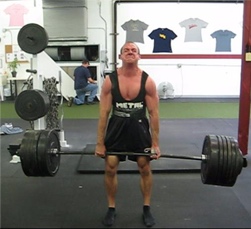
With the recent release of our Functional Stability Training resource, I thought you might be interested to check out this preview from one of my sections. In the two minute video below, I discuss how one can manage clients with a history of intervertebral disc issues:
To learn more about this resource, head here. To purchase, head here.
Sign-up Today for our FREE Newsletter and receive a four-part video series on how to deadlift!
We are creatures of habit - not only psychologically and socially, but physiologically as well. If you need proof, all you have to do is read up on shift work disorder, which shows that simply changing one's sleep and work schedule can have some profound consequences for our health.
With that in mind, it should come as no surprise that changing the time of day when one's workout routine takes place is a huge deal for everything from mood to performance. Perhaps the most common adjustment that takes place is when someone decides to exercise in the morning. It may be because a long day at work is too exhausting to be 100% when you hit the gym after it's over, or you may just not want to wait for equipment access in a crowded gym at 6PM. Or, it could be because a parent is super busy with kids' after-school activities, so first thing in the morning before they wake up is the best bet for getting in a strength and conditioning program.
Whatever the reason, the adjustment to exercise in the morning is without a doubt the toughest "time change" one could make. With that in mind, here are five keys to making it a smooth transition:
1. Get to bed earlier.
This seems like a no-brainer, but you'd be surprised at how many people complain that they can't get results from exercise in the morning without realizing that they're still going to be far too late at night.
If you're someone who is accustomed to sleeping 12AM-8AM, then racing to be to work at 9AM, it's going to be an adjustment if you want to start training at 6AM before you head to work. You're only making it tougher if you decide that you're simply going to sleep 12AM-5AM. It's also going to crush your productivity for the rest of the day, as you'll be sleep walking rather than enjoying the post-exercise energy boost most people experience. If you want to be up at 5AM or 6AM to train, you've got to be in bed by 10PM. In fact, I always tell my athletes that an hour of sleep before midnight is worth two hours after midnight.
2. Stand up for a bit.
Dr. Stuart McGill has made some fantastic observations on spine stiffness first thing in the morning. In a nutshell, when we lay down to sleep at night, our spine is decompressed, so the intervertebral discs actually collect water. This increased hydration status builds annular tension within the discs, and makes the spine stiffer overall. This isn't a good kind of stiffness, though; more stress is placed on the ligaments and discs than the soft tissue structures that typically protect them.
Simply standing upright and moving around decreases the hydration status of the discs - and, in the process, actually makes us shorter as the day goes on! While I don't know of many people that want to get shorter, the good news is that this height reduction reduces the spine stiffness and allows us to move the spine more safely and effectively. While disc hydration diminishes over the course of the entire day, the majority of it occurs in the first hour that we're awake.
With this in mind, you're someone with a history of back pain, you're probably best off not incorporating exercise in the morning, especially if your workout routine includes a lot of bending and rotating. If you're going for a walk or light jog, though, it's probably not a big deal.
Conversely, if you're someone who plans to use some of these more challenging compound movements and have to exercise in the morning, I'd encourage you to get up 30 minutes early and just focus on standing up, whether it's to read the paper, pack your lunch, or take the dog for a walk.
3. Take a hot shower before exercise in the morning.
One of the biggest struggles a lot of folks encounter is getting warmed up in the morning. Folks usually turn the heat down at night while they're asleep, and it's obviously colder outside at nighttime. You might think I'm nuts, but hopping out of bed and into a hot shower is a great "body temperature transition" strategy that bridges the gap between bed and exercise. And, since you'll be standing in the shower, it also helps to accomplish tip #2 from above!
It only has to be 25-30 seconds to get your body temperature up a bit, and then you can take your "real" shower after you sweat up a storm. As an alternative to shower #1, you can always splash some hot water on your face and drink a cup of coffee. There's no way you're getting out of shower #2, though, Smelly.
4. Extend the warm-up.
In line with points #2 and #3, it's a good idea to add a few more dynamic warm-up drills to your pre-exercise routine. Typically, our athletes do between eight and ten drills, but those who exercise in the morning are better off with as many as 15. It might add five minutes to your dynamic warm-up, but that's far better than spending far more than five minutes in physical therapy for an injury you got from insufficiently warming up!
In line with tip #2 from above, you likely want to focus on more standing variations in your mobility exercise selections.
I've heard thousands of different nutritional strategies outlined for those who want to exercise in the morning, but the truth is, everyone is different. I have known folks who will throw up anything solid that they consume prior to exercise, and others (myself included) who could eat a giant breakfast and keep it down just fine. For most, I think sipping on a shake as you start the training session is a good place to start. If you handle that fine, you can consider having some solid food before the training session, if you find that you're hungry in the middle of the training session.
6. Recruit a training partner.
A training partner is almost always a good idea, but this is especially true when you're up at the buttcrack of dawn and not necessarily in the mindset to really push yourself. Plus, when you're awake for exercise before the sun rises, you're far more likely to hit the snooze button if someone isn't waiting for you at the gym.
While training first thing in the morning isn't exactly ideal, it may be your only option for staying consistent with your workout routine - and consistency is the name of the game. Implement these strategies to get the most out of your early morning training sessions.
Sign-up Today for our FREE Newsletter and receive a four-part video series on how to deadlift!
It's widely known that approximately 80% of the population will suffer from lower back pain at some point during their lives. What isn't widely known, however, is that even those who are asymptomatic are usually walking around with a host of nasty stuff going on with their spines. Don't believe me?
A 1994 study in the New England Journal of Medicine found that in a study of MRIs of 98 asymptomatic individuals, 82% of those MRIs came back as positive for a disc bulge, protrusion, or extrusion at one level. And, 38% actually had these issues at more than one level. You can read the free full text HERE.
As the others discovered, it doesn't stop with disc issues, either - and that's where a great study from Soler and Calderon comes in. They looked at the incidence of spondylolysis (vertebral fractures) in elite Spanish athletes, and found that 8% of those they examined had them. Only about half of those diagnosed via imaging actually had back pain, though. The incidence was highest in track and field throwers, rowers, gymnasts, and weightlifters - and I'd expect that this figure is actually higher in the U.S., where we have more sports (hockey, baseball, lacrosse) involving violent extension and rotation, more contact sports, and more participation in weight training.
What does this mean for us? Well, as Chou et al. reported in The Lancet, "Lumbar imaging for low-back pain without indications of serious underlying conditions does not improve clinical outcomes. Therefore, clinicians should refrain from routine, immediate lumbar imaging in patients with acute or subacute low-back pain and without features suggesting a serious underlying condition." That's not the point of my article today, though; I'll leave that stuff to the physicians to decide and rehabilitation specialists to interpret and treat.
As fitness professionals, strength coaches, and even just fitness enthusiasts and athletes, we need to assume that there is are probably a lot of structural abnormalities going on in the spines we encounter - including our own. The programs we write and follow need to be sound and take these issues into account, considering differences in age, gender, sport participation, and injury history. The technique we use needs to position us so that we can avoid causing them to reach threshold. And, we need to appreciate that there is a risk-reward balance to be "struck" with everything we do in training because nobody will ever be "perfectly prepared" for the demands to be placed on their bodies.
Rather than lay all my thoughts out here, I'm going to direct you to some previous writing of mine:
1. This is my first post on the new blog, so apologies in advance if:
a) the font style or color is out-of-whack
b) it comes up in Portuguese (meaning that you’d have no idea what I am saying, anyway)
c) your computer freezes up on account of the complete and utter awesomeness that you’re beholding with the new site
Kidding aside, it’s been a royal pain in the butt thus far and I’m just anxious to have it done so that I can just go back to writing.
2. Believe it or not, as some of you probably have noticed, I haven’t blogged for a full week.There was just a ton of stuff to get gone for the new site as well as loads of other projects on my plate.
Interestingly, though, it was by far my best week of training since the spring.I had a great front squatting session on Tuesday, and although Wednesday was supposed to be a day off, I got antsy later in the day.So, I did a little sprint work – and it felt great.So, I figured what the heck: I might as well test my vertical jump and broad jump.I wound up jumping a personal best of 34.7 inches and then tying a personal best on the broad jump with 114 inches.As a cooldown, I wrestled a grizzly bear and then did walking lunges in the parking lot with an intern over each shoulder.Those whippersnappers will learn!
Random digressions aside, it’s very clear that this blog is completely counterproductive for my strength, power, and physique goals.In fact, I’d say that is roughly on-par with distance running as a competing demand for my attention and physiological recuperation.I’m going to take one for the team and keep writing, though; winners persevere.
(and in case you folks didn’t pick up on it, that was a joke)
Essentially, this is a survey of all the available research on the topic, and here is what they determined: “Only one trial was found that investigated the efficacy of PUFAs and antioxidants on tendinopathies. The findings suggest that some (low level) evidence exists to support the supplementation in the management of tendinopathies. Any conclusions based on this one article should be reached with caution. Subsequently, there is a distinct and clear need for well-planned randomized controlled trials that aim to investigate the efficacy of supplements in the management of tendinopathies including those of the rotator cuff.”
Meanwhile, we spend BILLIONS on NSAIDs, cortisone shots, and surgeries.Don’t you just love the medical model?While these options are certainly warranted in some situations, we’re studying for the wrong test by ignoring the role of PUFAs and antioxidants in the treatment of tendinopathies.
Chances are that the NIH won’t soon fund anything to look at this, though, as they are too busy doing the 38,736th study in history on creatine.
4. A good cartoon, in light of the week ahead:
5. Speaking of turducken, is anyone looking forward to listening to John Madden on Thanksgiving as much as I am? I mean, this is quite possibly the greatest broadcasting spectacle in football history, as Madden will be bouncing off the walls try to slip in as many Brett Favre references as possible - even if Favre and the Jets don't play until the following Sunday.
And, Frank Caliendo as Madden is awesome. They played this on the airplane on the ride back from Georgia a few weeks ago and everyone on board was laughing hysterically.
6. Another interesting study that ought to make you think:
Basically, the researchers found that college baseball players and swimmers were 3.23 and 2.95 times more likely (respectively) than their non-athlete counterparts to have disk degeneration.And, there was a clear association between disk degeneration and lower back pain.
Now, here is something to consider…I would be willing to bet that if you took these athletes and actually trained their “cores” the right way, they would be better off long-term than the nonathletes – in spite of the amount of disc degeneration that’s present already.I feel very strongly that multidirectional lumbar stability goes a long way in overcoming any structural flaws – from vertebral fractures (spondylolysis) to disc issues; there are a lot of structurally jacked up backs out there that are completely asymptomatic.
To me, it’s the folks who do nothing that are most at-risk of debilitating back pain long-term.When s**t hits the fan for them, they are playing behind the 8-ball, as they’re older and completely untrained.So, they are starting from scratch when it’s the hardest to start from scratch.Food for thought.
In the meantime, pick up a copy of Combat Core and save yourself.It’s the best “core training” program out there.
7. That last thought was pretty heavy with techy stuff, huh?Did it blow your mind?You know, kind of like it blew your mind when David Hasselhoff talked to that car – and the car actually talked back?
Yeah, that was crazy.
Anyway, that's all for this week. Did you miss me?
1. It's going to be a quick one today, as we're getting ready to leave for Cassandra Forsythe's wedding in Vermont. For the record, this will likely be the last time she's referred to as Cassandra Forsythe; she'll be Forsythe-Pribanic by the end of the weekend!
2. One more reason to not use the abductor machine: OUCH!
3. Researchers have found that participation in a football game leads to a HEIGHT loss of almost one centimeter - likely due to compressive forces. Just imagine what happens when you put 500 pounds on your back and go for a squatting session! I haven't seen any acute research in this regard, but there is evidence to show that retired weightlifters have reduced disc heights when compared with controls who didn't lift. I'd be willing to bet that they also have fewer broken hips, can carry their own groceries, and pick up way more hotties in the convalescent home, so I'll take functional capacity over a perfect MRI anyday.
4. Good points on the negative effects of flip-flops, but I don't buy the argument that barefoot training is just as bad. The only reason it's "bad" is that you can't put orthotics on a bare foot...
5. My girlfriend cooked up some protein bars from John Berardi's Gourmet Nutrition cookbook; awesome stuff! It's the summer in the Northeast, so there are a lot of blueberries on-hand; they're a great addition to the apple cinnamon bars, if you haven't tried them already.
6. Tony Gentilcore started a training log over at T-Nation that describes a lot of the madness at Cressey Performance in our training group. It's worth checking out - at the very least, to make sure that you make fun of Tony.
7. I mentioned it in my newsletter the other day, but if you are a fitness professional and haven't signed up for Ryan Lee's Bootcamp, I'd highly recommend you check it out.
8. Atta boy, Sam! Talk about clutch - and they had an 11-10 extra innings walk-off win last night. Good luck this weekend, Sudbury Legion.
I've got to run - but not before leaving you with a bit of nostalgic weekend motivation from the greatest motivator of all time!