A few years ago, I read What the Dog Saw, a collection of short stories from popular author Malcolm Gladwell.
In one particular short story, Gladwell introduces the concept of "risk homeostasis." Essentially, risk homeostasis refers to the fact that modifications that are designed to make things safer often eventually have a break-even effect on safety because of adaptations to those modifications. In other words, something that should protect us doesn't because new compensatory factors make things more dangerous.
As an example, Gladwell observers that taxi drivers who are given anti-lock brakes actually wind up with higher incidences of traffic violations and accidents. Presumably, this occurs because the drivers feel they can drive faster and more aggressively because of this added "protection."
In another case, a study showed that adding childproof lids to medicine bottles actually increased the likelihood that children would die from accidental overdose of consuming drugs not meant for them. The added “safety” leads to adults being less cautious with where they hide bottles of pills.
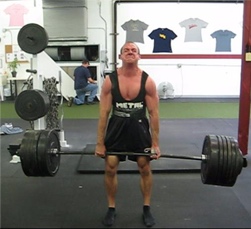
While watching an absolutely atrocious YouTube video with some of the worst box squat technique in history the other day, my thoughts flashed back to this concept of risk homeostasis from when I read Gladwell's work. There are actually some remarkable parallels in the world of strength and conditioning.
1. Wearing a belt.
When a lifter throws on a belt, he assumes that it will make an exercise safer for him. While the research isn't really in agreement with this assertion, we'll roll with this assumption.
In real life, most lifters throw on a belt because it helps them handle additional weights - and at these weights, their form usually deteriorates rapidly, and does so under additional compressive loading.
2. Popping anti-inflammatories and getting cortisone shots.
When a doctor gives you a cortisone shot or recommends oral anti-inflammatories, it's because he believes you have some level of inflammation, whether it's a bursitis, tenosynovitis, or other issue. This short course of anti-inflammatories will reduce that inflammation.
You rarely see these issues in isolation, though; they're usually accompanied by degenerative changes (e.g., tendinosis) or structural changes (e.g., bone spurs) that could also be causing your symptoms. Unfortunately, your anti-inflammatories don't know that; they just know they're supposed to kill off all your pain. They make you asymptomatic, but not necessarily "healthy."
Many individuals get a cortisone shot or take a few days of NSAIDs and assume they can just go right back to training hard with no restrictions because their pain is gone. A few weeks or months later (when the cortisone shot wears off), they're back in pain (and usually it's worse than before) because they've done nothing to address the underlying causes of the problem in the first place. They shut off the inflammation and pain, but kept the degeneration, structural changes, and stupid.
The anti-inflammatory intervention is supposed to be part of a treatment plan to make folks healthier, but actually gives them a false sense of security, which in turn makes an injury or condition worse.
3. Lifting alongside an "experienced" coach who has done stupid s**t for decades, but has never been hurt.
It's not uncommon to feel a sense of security when you train with a coach with tons of time "under the bar" himself. His training background - and reportedly clean injury history - gives you peace of mind and you buy into his system. And, you continue lifting heavier and heavier in poor form because he's proof that it works, right?
Unfortunately, he's a sample size of one.
His experience should make training safer, but instead, it just leads you to take more poorly calculated risks with your training.
As an example, I did this while goofing around a few years back, but I'd never let one of my athletes try it. There are enough ugly box jump videos out there on YouTube to appreciate that a lot of coaches don't have the same kind of self-restraint.
4. Wearing elbow sleeves and knee wraps.
Elbow sleeves and knee wraps are incredibly common in the world of strength sports, and with good reason: they can really help with getting or keeping a joint warmed-up.
The only problem is that most lifters use them just so that they can power through the exact exercises that caused the joint aches in the first place.
As an example, a lot of lifters lack the upper back and shoulder mobility to use a narrow grip position on the barbell when back squatting, and the medial (inside of the) elbow takes a beating as a result. Rather than doing some shoulder mobility drills, they just throw on a band-aid in the form of an elbow sleeve.
5. Picking "joint-friendly" strength exercises.
There are lots of ways to deload a bit in the context of strength exercise selection. Maybe you do some single-leg work instead of squatting. Or, maybe you do some barbell supine bridges in place of deadlifting. These substitutions usually make a strength training program safer.
That is, of course, unless you do them with horrendous technique. Sadly, this isn't uncommon. You see people who meticulously prepare for squatting and deadlifting and heavily scrutinize their technique with video analysis, yet they'll blow through other exercises with terrible form. They expect exercise selection alone to make their strength training program safer, but compensate for this added safety by butchering technique.
Of course, these are only five examples of how risk homeostasis applies to strength and conditioning programs, and there are certainly thousands more. Where do you see good intentions go astray in your training? I'd love to hear your thoughts in the comment section below.
Sign-up Today for our FREE Newsletter and receive a four-part video series on how to deadlift!
I turn 28 today, so in hopes of distracting myself from the painful realization that I'm starting to go bald, I thought I'd focus on the positives of my existence in contexts that would appeal to you. Below, you'll find 28 of my favorite things - most of which are at least loosely related to fitness, nutrition, strength and conditioning, and sports.
1. Favorite Nickname: Power Alleys. This seemed like a good starting point, as power alleys are bald spots. Credit for this one goes to Mets pitching prospect Tim Stronach.
2. Favorite Thing About Cressey Performance: The camaraderie among the athletes/clients. I think the hard thing to appreciate about our facility without experiencing it first-hand and being there on a regular basis is that it's as much about the environment and attitude as it is about the expertise and programming. I'm psyched that we've not only created an environment where clients can improve physically, but one in which they can thrive socially, too.
3. Favorite Book I've Read Related to Fitness:Diagnosis and Treatment of Movement Impairment Syndromes, by Shirley Sahrmann. This book got me thinking more about dysfunction and less about pathology. Quality of movement is often far more important than anything a MRI or x-ray can ever tell you.
4. Favorite Book I've Read Unrelated to Fitness: This is a top-up between The Tipping Point and A Prayer for Owen Meany. They might be taken over, however, by one of the gifts I just got for my birthday from CP Client Steph Holland-Brodney.
5. Favorite DVD I've Watched:The Indianapolis Performance Enhancement Seminar DVD Set. Bill Hartman's presentation on "Stiff vs. Short" alone makes this a fantastic resource, and the rest is just gravy. I reviewed it HERE.
6. Favorite DVD I've Co-Created: The Building the Efficient Athlete DVD set. I think I'm most proud of this resource because it's something that provided something I so desperately wanted - but couldn't get - during my college education. Effectively, it's a resource that blends book memorization with real-world practice with a focus on functional anatomy, assessments, and troubleshooting common exercises.
7. Favorite Seminar I've Attended:The Perform Better 3-Day Functional Training Summit. Each year, they get better and better. Check out Chicago or Long Beach this year if you missed Providence.
8. Favorite Athlete of All Time: Barry Sanders. I can't imagine an guy with better kinesthetic awareness, body control, or ability to turn a complete disaster of a play into a 90-yard touchdown run - while carrying two defensive linemen on his back.
9. Favorite Athlete of All-Time that you've probably never heard of: Jerry Sichting. He played for the Celtics from 1985 to 1988, and I'll always remember the night Sichting - at a heigh of 6-1 - got in a fight with 7-4 Ralph Sampson during the 1986 NBA Finals. At the time, I was a five-year old shadow boxing in my living room yelling at the top of my lungs.
10. Favorite Place to Visit: Fenway Park
11. Second Favorite Place to Visit: Gampel Pavilion at the University of Connecticut. It's an incredible environment in which to watch college basketball, and it's also where I spent just about all my time from 2003 to 2005.
12. Favorite Exercise: was this ever in question?
13. Favorite Sites I Visit Just About Every Day: T-Nation.com, MinorLeagueBaseball.com, ESPN.com, Sports.Yahoo.com, WilliamInman.com, 38Pitches.com, ShawnHaviland.Blogspot.com, MetrowestDailyNews.com, StrengthCoach.com, MikeReinold.com, RobertsonTrainingSystems.com, BillHartman.net, AlwynCosgrove.Blogspot.com, DieselCrew.com, PrecisionNutrition.com, BrianStPierreTraining.com, Tony Gentilcore's Blog, Boston.com, BarstoolSports.com, Facebook.com, EricCressey.com.
14. Favorite Kind of Injury to See (weird category, I know): Labral Tears (SLAP lesions), or really any kind of shoulder or elbow pain in pitchers. You've got so many potential causes that it's kind of fun (for me, not the athlete) to go through a process of elimination to see what combination of factors caused it. There are all the classic flexibility deficits in pitchers, plus scapular instability, poor thoracic spine mobility, plus faulty mechanics, plus inappropriate training volumes, plus weak lower bodies. It's kind of like peeling back the layers on an onion to see what shakes free. It's also a great scenario to illustrate what I talked about with respect to diagnostic imaging in #3 from above. All of these guys will have labral fraying and rotator cuff partial thickness tears at the very least; it's our job to fix them up and make them work efficiently in spite of these structural deficits in situations where surgery isn't warranted.
15. Favorite Class I Took in School: Gross Anatomy. Yes, I cherished the semester I spent with a bunch of cadavers.
16. Favorite Healthy Food: Apple-Cinnamon Protein Bars from John Berardi's Gourmet Nutrition Cookbook. Admittedly, I often just eat the batter before it ever gets cooked. Not good, I know.
17. Favorite Piece of Equipment We Have at CP: Giant Cambered Bar. Along with the safety squat bar and front squat set-up, this bad boy has allowed me to keep squatting even though my right shoulder decided a long time ago that traditional back squats weren't a good idea. It's also a great asset for working with overhead throwing athletes who should avoid the externally rotated, abducted position under load.
18. Favorite Thing About Having a Blog: I can write a lot more casually than in my newsletter, which tends to be more geeky. And, I can post videos of this kid rocking out:
19. Favorite Mobility Drill: Walking Spiderman w/Overhead Reach. I love this drill because you're covering so many things at once. You'll get thoracic spine extension and rotation from the reach, and hip flexor and adductor length in the lower body from the lunge angle. Keep an eye out for more new movements along these lines in the months to come as we film the sequel to the Magnificent Mobility DVD.
20. Favorite Pastime I Had to Give Up: Fantasy Baseball/Basketball. During my sophomore year of undergrad, I finished fourth in the world in NBA.com's Virtual GM contest. Long story short, if you want to be really good at fantasy sports with that kind of set-up, you've got to put a lot of time into it - and realize that it won't make girls like you. You'll also find yourself watching games in which you'd otherwise have absolutely no interest. I couldn't do it half-ass (aside from the CP Fantasy Football League), so I gave it up.
21. Favorite Inedible Toy: Rubber Steak.
Suffice it to say that Fire & Ice wouldn't allow us to eat a birthday cake inside their restaurant on Saturday night in celebration of my awesomeness. So, in celebration of their suckiness, none of us (16 in all) will ever eat again - and I was reduced to gnawing on dog toys.
22. Favorite Birthday Excitement: Apparently, it's going to be taking my car in to get work done, buying a new laptop, and then coaching 'em upat CP. There will also be a dominant upper body lift at CP that will undoubtedly feature Kevin Larrabee missing 300...again...and again).
24. Favorite Strength and Conditioning Coach Who is Having Surgery on my Birthday: Josh Bonhotal, Chicago Bulls. I talked with Josh yesterday and he informed me that he was finally having his ACL fixed today in celebration of my birthday. Nothing says "Happy Birthday, Buddy" like taking a chunk out of your patellar tendon and turning it into an anterior cruciate ligament. It's kind of like planting a tree on Earth Day. What a nice gesture.
25. Favorite Article Series I've Written:A New Model for Training Between Starts (Part 1and Part 2). These articles were actually picked up by Collegiate Baseball Magazine as front-page features, and I received a lot of great feedback about them. If there is one thing I do before I retire, it's convincing the world of the evils of distance running for pitchers. I'd put the Shoulder Savers series in a close second
26. Favorite Supplement: Fish Oil. It's followed closely by Vitamin D. You need both - and probably a lot more than you think. I'm a simple guy when it comes to this stuff.
27. Favorite Random Website a Buddy Texted to Me Last Week: www.EasyCurves.com. This thing is hilarious. A special thanks goes out to Jesse Burdick for making me just a little bit dumber with that.
28. Favorite Sign of Athlete Dedication for the Month: We have two college pitchers up here fromPennsylvania for the month to work on getting bigger, stronger, faster, and more flexible in hopes of a nice velocity jump on the mound, and the obvious injury prevention benefits of such training. That's all well and good - until you hear that they got an unfurnished apartment in Hudson, MA. These guys are sleeping on mattresses on the floor, and all they brought were a few lamps, a TV, some books, and a whole lot of enthusiasm and motivation. That's committment to training - and just the kind of guys we like to have around Cressey Performance.
What kind of sacrifices are you making to get better and move closer to your goals? I'm not sure that sleeping on a mattress on the floor is necessary, but it says a lot.
With that in mind, I'm not taking today off. There is work to be done and I love to do it, birthday or not.
I'm in the process of reading Blink by Malcolm Gladwell. It's a fantastic book - and one of the foremost messages Gladwell works to convey is that split-second decisions - those made seemingly subconsciously - are in many cases better than those that are thought-out with great time and effort.
As is always the case with a books I read that are seemingly unrelated to strength and conditioning, I got to thinking about how this applies to the industry in which I work - and I started to immediately see applications. The best coaches are the ones who instinctively know exactly what to say to clean up a movement - and this requires not only quick recognition of what's wrong, but also the ability to know exactly what to say to fix the problem. For instance, you can't see an athlete squatting who is breaking at the knees instead of the hips, and then go home and think about it for 24 hours before coming back to coach the movement correctly.
In one instance, Gladwell makes his point in the context of basketball:
Basketball is an intricate, high-speed game filled with split-second, spontaneous decisions. But that spontaneity is possible only when everyone first engages in hours of highly repetitive and structured practice - perfecting their shooting, dribbling, and passing, and running plays over and over again - and agrees to play a carefully defined role on the court.
In other words, if you want to be successful in a challenge that depends on effective split-second decision-making, you need to have prepared yourself in terms of knowledge and practice. Each week, I get close to a dozen emails from up-and-comers in the industry asking for my advice on how to advance their career, and I give them three pieces of advice that - if carried out - will immediately set them apart from the rest of their peers.
Step 1 is to master anatomy. You can't be a mechanic if you don't know where the engine is, or what its constituent parts are. Memorization is boring, but you have to do it; it is the basis for everything that you do. If you are a fitness professional - or aspiring to be one - and you can't answer the following three questions, then you have room to improve:
a. What are three flexors of the hip?
b. What are the points of attachment of the latissimus dorsi?
c. What are three muscles that attach to the coracoid process of the scapula?
I am not trying to put myself on a high-horse, as I'm far from knowing every subtle intricacy of the human body. I do, however, know enough to realize that I am going to keep learning and it's always going to keep benefiting my clients.
While any anatomy book will do, I'm partial to Kinetic Anatomy for those looking to get a good start. And, if you have the opportunity to take a course in Gross Anatomy, definitely do so - or at the very least, check out the Bodies exhibit when it's at a museum near you.
Step 2 is to take that anatomy foundation and apply it in a function context. In other words, what happens when one muscle doesn't do its job? How can poor mobility in one area lead to instability elsewhere? How can certain muscles be both synergists and antagonists, depending on the plane of motion in question?
Functional anatomy is largely the reason that Mike Robertson and I made the Building the Efficient Athlete DVD set; we felt strongly that there was a need to improve on the rudimentary anatomy teaching that most fitness professionals receive in certification and academic programs.
Step 3 is to acquire an internship where you can watch others apply their knowledge and get practice applying your own in a controlled environment. With an internship, you learn about professionalism, coaching cues, and programming - and you learn how working with clients and athletes effectively blends your knowledge with your everyday demeanor. As an extension of this step, I feel strongly that it's important to get out during your career and interact with as many colleagues as possible to see what bits of wisdom you can clean from their coaching styles. And, of course, attend seminars, and read everything you can get your hands on.
Once you've gotten through step 3, it is time to get out there and practice in the "real world" by interacting with as many clients as you possibly can. These individuals will all have something to teach, and it's a chance for you to apply everything you've learned.
One thing you will notice is completely absent from my recommendations is me encouraging people to go out and get more certifications. Frankly, a certification is simply a foot in the door, and there aren't any out there - even the so-called "gold standards" - that impress me. If you are going to spend hundreds of dollars with the intention of becoming a better professional, there are much better investments than just paying for a certification that merely amounts to a piece of paper you can frame. I'd rather spend the money on books, seminars, or travel expenses to see people who actually coach.
Take care of those three steps, and in my eyes, you'll be well on your way to the "subconscious mastery" to which I alluded earlier.
A Quick Note on a Great Sale for a Great Cause
Speaking of Building the Efficient Athlete, as you may recall, I announced a sweet sale last week where a small charitable, tax-free donation can save you 20% on a boatload of our products. This offer ends on Thursday at midnight, so don't delay. You can find the details HERE.