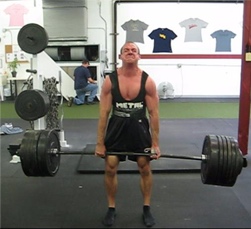
We often hear that an elbows-tucked bench press technique is more shoulder friendly than an elbows-flared approach. Nobody really ever seems to discuss why this is the case, though - so I thought I'd devote today's video blog to it:
If you're looking to dig deeper into topics like this, be sure to check out my popular resource, Sturdy Shoulder Solutions.
Sign-up Today for our FREE Newsletter and receive a four-part video series on how to deadlift!
I thought I'd use today's post to throw out some thoughts on training the shoulders.
1. In the upper extremity, the assessments are often the solutions, too.
Imagine you're assessing an athlete, and their squat pattern is absolutely brutal. Usually, the last thing you're going to do is go right to a squat as part of their training. In other words, simply coaching it differently usually won't improve the pattern immediately. Rather, you typically need "rebuild" the pattern by working with everything from ankle and hip mobility to core control, ultimately progressing to movements that replicate the squatting pattern.
Interestingly, the upper extremity is usually the opposite in that the assessment might also be the drill you use to correct the movement. For instance, an aberrant shoulder flexion pattern like this...
...might be quickly corrected with some of these three cues on a back to wall shoulder flexion pattern.
This is also true of push-up assessments and shoulder abduction and external rotation tests we do; funky patterns are usually cleaned up quickly with some subtle cueing. This just isn't the case as much in the lower body, though. Why the difference?
My theory is that because we're weight-bearing all day, the lower extremity is potentially less responsive to the addition of good stiffness in the right places. Conversely, a little bit of stiffness in serratus anterior, lower trap, or posterior cuff seems to go a long way in quickly improving upper extremity movement. My experience with the Postural Restoration Institute also leads me to believe that creating a good zone of apposition can have lead to a more pronounced transient movement in the upper extremity than it does in the lower extremity. This is likely because the rib cage is directly involved with the shoulder girdle, whereas the relationship with the lower extremity (ribs --> spine --> pelvis) is less direct.
These differences also seem to at least partially explain why upper extremity posture is much easier to change than lower extremity positioning. It's far more common to see a scapular anterior tilt change markedly than it is to see an anterior pelvic tilt substantially reduced.
Just thinking out loud here, though. Fun stuff.
2. Anterior shoulder pain usually isn't "biceps tendinitis."
First off, true tendinitis is actually quite rare. In this landmark paper, Maffulli et al. went to great lengths to demonstrate that the overwhelming majority of the overuse tendon conditions we see are actually tendinOSIS (degenerative) and not tendinITIS (inflammatory). It may seem like wordplay, but it's actually a very important differentiation to make: if you're dealing with a biceps issue, it's probably tendinosis.
Second, if you speak with any forward thinking orthopedic shoulder specialist or rehabilitation expert, they'll tell you that there are a lot of differential diagnoses for anterior (front) shoulder pain. It could be referred pain from further up (cervical disc issues, tissue density at scalenes/sternocleidomastoid/subclavius/pec minor, or thoracic outlet syndome), rotator cuff injury or tendinopathy, anterior capsule injury, a lat strain or tendinopathy, labral pathology, nerve irritation at the shoulder itself, arthritis, a Bankart lesion, osteolysis of the distal clavicle, AC joint injury, and a host of other factors.
3. Thoracic outlet surgery really isn't a shoulder surgery.
Over the past few years, each time a professional pitcher gets thoracic outlet surgery, you see many news outlets call it "shoulder surgery." Sorry, but that really isn't the case unless you have a very expansive definition of the word "shoulder."
With this intervention, the surgeon is removing the first (top) rib to provide "clearance" for the nerves and vascular structures to pass underneath the clavicle.
Additionally, surgeons usually opt to perform a scalenectomy, where they surgically remove a portion of the anterior scalenes, which may have hypertrophied (grown) due to chronic overuse. Again, this is not a "shoulder" procedure.
Finally, more and more surgeons are also incorporating a pec minor release as part of the surgical intervention. This is because the nerve and vascular structures that may be impinged at the scalenes or first rib can also be impinged at the coracoid process of the scapular if an individual is too anterior-tilted. While the coracobrachialis and short head of the biceps both attach here, the pec minor is likely the biggest player in creating these potential problems.
This, for me, is the only time this becomes somewhat of a "shoulder" surgery - and it's an indirect relationship that doesn't truly involve the joint. We're still nowhere near the glenohumeral (ball-and-socket) joint that most people consider the true shoulder.
All that said, many people consider the "shoulder girdle" a collection of joints that includes the sternoclavicular, acromioclavicular, glenohumeral, and scapulothoracic articulations. In this case, though, the media just doesn't have a clue what they're trying to describe. With that in mind, hopefully this turned into somewhat of an educational rant.
4. Medicine ball scoop tosses tend to be a better than shotputs for cranky shoulders.
Rotational medicine ball training is a big part of our baseball workouts, and it's something we try to include as an integral part of retraining throwing patterns even while guys may be rehabilitating shoulder issues. When you compare rotational shotputs with rotational scoop tosses...
...you can see that the scoop toss requires far less shoulder internal rotation and horizontal adduction, and distraction forces on the joint are far lower at ball release. The shotput is much more stressful to the joint, so it's better saved for much later on in the rehab process.
5. Adequate rotator cuff control is about sufficient strength and proper timing - in the right positions.
To have a healthy shoulder, your cuff needs to be strong and "aware" enough to do its job in the position that matters. If you think about the most shoulder problem, there is pain at some extreme: the overhead position of a press, the lay-back phase of throwing, or the bar-on-your back position in squatting. For some reason, though, the overwhelming majority of cuff strength tests take place with the arms at the sides or right at 90 degrees of elevation. Sure, these positions might give us a glimpse at strength without provoking symptoms, but they really don't speak much to functional capacity in the positions that matter.
With that in mind, I love the idea of testing rotator cuff strength and timing in the positions that matter. Here's an example:
Obviously, you can make it even more functional by going into a half-kneeling, split-stance, or standing position. The point is that there are a lot of athletes who can test pretty well in positions that don't matter, but horribly in the postures that do.
6. Pre-operative physical therapy for the shoulder is likely really underutilized.
It's not uncommon to hear about someone with an ACL tear going through a month or so of physical therapy before the surgery actually takes place. Basically, they get a head start on range-of-motion and motor control work while swelling goes down (and, in some cases, some healing of an associated MCL injury may need to occur).
I'm surprised this approach isn't utilized as much with shoulder surgeries. It wouldn't be applicable to every situation, of course, but I think that in some cases, it can be useful to have a pre-operative baseline of range-of-motion. This is particularly true in cases of chronic throwing shoulder injuries where regaining the right amount of external rotation is crucial for return to high level function. Adding in some work on cuff strength/timing, scapular control, and thoracic mobility before hopping in a sling for 4-6 weeks probably wouldn't hurt the case, either. And, as an added bonus, if this was more common, I think we'd find quite a few people who just so happen to become asymptomatic, allowing them to cancel their surgeries. It's probably wishful thinking on my part, but that's what these random thoughts articles are all about.
For more information on approaches to evaluating, coaching, and programming for the shoulder, be sure to check out Sturdy Shoulder Solutions.
Have a great weekend!
Sign-up Today for our FREE Newsletter and receive a four-part video series on how to deadlift!
Show and Go: High Performance Training to Look, Feel, and Move Better - This was obviously my biggest project of 2010. I actually began writing the strength and conditioning programs and filming the exercise demonstration videos in 2009, and put all the "guinea pigs" through the four-month program beginning in February. When they completed it as the start of the summer rolled around, I made some modifications based on their feedback and then got cracking on writing up all the tag along resources. Finally, in September, Show and Go was ready to roll. So, in effect, it took 10-11 months to take this product from start to finish - a lot of hard work, to say the least. My reward has been well worth it, though, as the feedback has been awesome. Thanks so much to everyone who has picked up a copy.
Optimal Shoulder Performance - This was a seminar that Mike Reinold and I filmed in November of 2009, and our goal was to create a resource that brought together concepts from both the shoulder rehabilitation and shoulder performance training fields to effectively bridge the gap for those looking to prevent and/or treat shoulder pain. In the process, I learned a lot from Mike, and I think that together, we brought rehabilitation specialists and fitness professionals closer to being on the same page.
Why President Obama Throws Like a Girl - A lot of people took this as a political commentary, but to be honest, it was really just me talking about the concept of retroversion as it applies to a throwing shoulder - with a little humor thrown in, of course!
Overbearing Dads and Kids Who Throw Cheddar - This one was remarkably easy to write because I've received a lot of emails from overbearing Dads asking about increasing throwing velocity in their kids.
What I Learned in 2009 - I wrote this article for T-Nation back at the beginning of the year, and always enjoy these yearly pieces. In fact, I'm working on my 2010 one for them now!
The Skinny on Strasburg's Injury - I hate to make blog content out of someone else's misfortune, but it was a good opportunity to make some points that I think are very valid to the discussion of not only Stephen Strasburg's elbow injury, but a lot of the pitching injuries we see in youth baseball.
Surely, there are many more to list, but I don't want this to run too long! Have a safe and happy new year, and keep an eye out for the first content of 2011, which is coming very soon!
I made an effort to get more videos up on the site this year, as I know a lot of folks are visual learners and/or just enjoy being able to listen to a blog, as opposed to reading it. Here are some highlights from the past year:
The Absolute Speed to Absolute Strength Continuum - Regardless of your sport, there are valuable take-home messages. I just used throwing velocity in baseball pitchers as an example, as it's my frame of reference.
Should Pitchers Overhead Press? - This was an excerpt from Mike Reinold and my Optimal Shoulder Performance seminar (which became a popular DVD set for the year).
Shoulder Impingement vs. Rotator Cuff Tears - Speaking of Mike, here's a bit from the man himself from that seminar DVD set.
Thoracic and Glenohumeral Joint Mobility Drills - The folks at Men's Health tracked me down in the lobby at Perform Better in Providence and asked if I could take them through a few shoulder mobility drills we commonly use - and this was the result.
Cressey West - This kicks off the funny videos from the past year. A few pro baseball players that I program for in a distance-based format created this spoof video as a way of saying thank you.
Tank Nap - My puppy taking a nap in a provocative position. What's more cute?
Matt Blake Draft Tracker - CP's resident court jester and pitching instructor airs his frustrations on draft day.
1RM Cable Horizontal Abduction - More from the man, the myth, the legend.
You can find a lot more videos on my YouTube page HERE and the Cressey Performance YouTube page HERE.
A New Paradigm for Performance Testing - This two-part feature was actually an interview with Bioletic founder, Dr. Rick Cohen. In it, we discuss the importance of testing athletes for deficiencies and strategically correcting them. We've begun to use Bioletics more and more with our athletes, and I highly recommend their thorough and forward thinking services.
A New Paradigm for Performance Testing: Part 1A New Paradigm for Performance Testing: Part 2
I already have a few series planned for 2011, so keep an eye out for them! In the meantime, we have two more "Best of 2010" features in store before Friday at midnight.
Sign-up Today for our FREE Newsletter:
Though a somewhat "normal" day at the gym, yesterday marked Cressey Performance's three-year anniversary.
While my business partner's blog post yesterday did an excellent job of doling out "thank yous" to a lot of the important people who have been so involved in our success - from clients to parents, coaches, interns, and significant others - I wanted to add my own two cents on the matter today. More than anything, I really wanted to highlight a sentence that illustrates what makes me the most proud about where CP has been, where it is, and where it's going.
We've done this for the right reasons, and we've done it the right way.
I read a business development blog post by Chris McCombs the other day where he wrote something that really hit home for me. When he was talking about how he decides to accept or reject a new project/opportunity, here is one of his guidelines:
"Only Take on Projects That Are In Line With My Current Values and Fulfill Me Beyond Just The Money - A project must fulfill me in some way BESIDE just money...too many people spend their life JUST chasing a buck; to me, that's no way to live. For me, the money must be there, but it should fulfill me personally, be fun, help a lot of people, and build and be in line with my current brand and brand equity."
Back in 2007, I had a tough decision to make. My online consulting business had really taken off, and the Maximum Strength book deal was in the works. My other products - Magnificent Mobility, The Ultimate Off-Season Training Manual, and Building the Efficient Athlete - were selling well and getting great reviews, and I'd just had a study published in the Journal of Strength and Conditioning Research. This website was growing exponentially in popularity, and I had just wrapped up my first year on the Perform Better tour - so lots of doors were opening for me on the seminar front to present all over the world - and I could have stayed home and just written all day, every day.
I was getting really crunched for time, as I was already training clients 8-13 hours per day, seven days per week, as my in-person clientele had rapidly grown. My phone rang off the hook for about three weeks after Lincoln-Sudbury won a baseball state championship after I'd trained several of their guys, and one of my athletes was named state player of the year. And, after being featured on the front page of the Boston Globe with a nipple so hard I could cut diamonds, I was in demand as a t-shirt model (okay, not really - but it made for an awesome blog post, The School of Hard Nipples).
I was exhausted and stressed - but absolutely, positively, "living the dream" that I'd always wanted.
To make matters a bit more interesting, I had just started dating a great girl (now my fiancee) who I really had a good feeling was "the one" after about three months. The work days, however, were insanely long and I was worried that I'd screw up a good thing by not spending enough time with her.
Every business development coach out there would have seen a "simple" answer to all my problems: stop training people in person. Just write, consult, make DVDs, and give seminars. It would have cut my hours by 80% and still allowed me to earn a pretty good living - and enjoy plenty of free time. There was a huge problem with that, though; as Chris wrote, it wouldn't "fulfill me personally, be fun, help a lot of people, and build and be in line with my current brand and brand equity." I like doing evaluations, writing programs, coaching, sweating, training with my guys, cranking up the music, helping people get to where they want to be, collaborating with and learning from other professionals, and watching my athletes compete - whether it's at some high school field or at Fenway Park. Giving that up wasn't an option; I guess I'd have just been a crappy business coaching client, as I would have been stubborn as an ass on giving that up.
Fortunately for me, Pete Dupuis, my roommate from my freshman year of college, had just finished his MBA and was in the midst of a job search. And, during that MBA, he'd started to train with me and packed on a ton of strength and muscle mass - making him realize and truly appreciate the value in what I was doing (especially since he was and is a goalie in a very competitive soccer league). Pete had also met and become friends with a ton of my clients - and taken a genuine interest in my baseball focus, as a lifelong Red Sox fan. Almost daily, Pete would encourage me to do my own thing and let him handle all the business stuff for me.
Simultaneously, Tony Gentilcore was ready for a change of scenery on the work front. Having been Tony's roommate and training partner for almost two years at that point, I knew he was a genuinely great guy, that he'd read everything on my bookshelf, and that he could coach his butt off and "walk the walk." He, too, had met a lot of my clients - so there was continuity from the get-go.
So, on July 13, 2007, Cressey Performance was born. Here is what we started with.
Boatloads of renovations and equipment additions later, it wound up looking like this.
Of course, we outgrew and demolished this space after about nine months and moved three miles east to a facility twice the size. And, we've continued to grow right up to this day; June was our busiest month ever, and July should be busier. We've got regular weekly clients who come from four states (MA, NH, CT, RI), and in the baseball off-season, I have college and pro guys who come from the likes of OH, AZ, CA, SC, NC, GA, FL, and VA. And, we had 33 applicants for this summer's internships.
To be very candid, though, I don't consider myself a very good "businessman." No offense to Pete or Tony, either, but I don't think they even come close to the textbook definition of the word, either. We just try to be good dudes. "We've done this for the right reasons, and we've done it the right way."
We don't allocate a certain percentage of our monthly revenues to advertising. In fact, we haven't spent a single penny on advertising - unless you count charitable donations to causes that are of significance to us.
We don't search high and low for new revenue streams to push on our clients. In fact, if I get one more MonaVie sales pitch, I'm going to suplex whoever delivered it right off our loading dock. Rather, we bust our butts to set clients up for success in any way possible - and trust that those efforts will lead to referrals and "allegiance" to Cressey Performance. We ask what they want from us and modify our plans accordingly. It's what led to us bringing in manual therapy, a pitching cage, and, of course, pitching coach/court jester Matt Blake's timeless antics.
Along those same lines, we don't measure our success based on revenue numbers; we measure it based on client results. In three years of seeing LOADS of baseball players non-stop, we've only had three arm surgeries: one shoulder and two elbow. All three were athletes who came to us with existing injuries, and in each case, we kept them afloat as long as we could and trained them through their entire rehabilitation. I don't want to toot our own horn, but this is a remarkable statistic in a population where over 57% of pitchers suffer some form of shoulder injury during each competitive season - and that doesn't even include elbows! And, our statistics don't even count literally dozens of players who have come to us after a doctor has told them they needed surgery, but we've helped them avoid these procedures. The college scholarships, draft picks, state titles, individual honors, and personal bests in the gym are all fantastic, but I'm most proud of saying that we've dedicated ourselves to keeping athletes healthy so that they can enjoy the sports they love.
The same goes for our non-competitive athlete clients. The fat loss and strength gains they experience are awesome and quantifiable, but beyond that (and more qualitatively), I love knowing that they're training pain-free and are going to be able to enjoy exercise and reap the benefits of training for a long time.
We don't penny-pinch during our slowest times of the month (late March through mid-May - the high school baseball season). We see it as an opportunity to do more staff continuing education, renovate the facilities, and get out to watch a lot of baseball and support our athletes. And, we adjust our hours to open up on Sundays and stay later on weeknights during the baseball season to make it easier for athletes to get in-season training in whenever they can. If a pitcher wants to come in and get his arm stretched out before or after an outing, he stops by and we do it for him - but don't charge him a penny for it. It's about setting people up for success.
We don't try to just "factory line" as many clients through our facility as possible with everyone on the same program. You might walk into CP and see 20 different clients on 20 different programs - because a 16-year old pitcher with crazy congenital laxity is going to have a markedly different set of needs than a 16-year-old linebacker with shoulder mobility so bad that he needs help putting a jacket on. One program on one dry erase board for hundreds of athletes isn't training; it's babysitting.
Taking this a step further, we don't boot clients out after a certain amount of time. Clients take as long as needed to complete the day's program. And, when they're done (or before they even begin), loads of our clients spend time hanging out in the office just shooting the breeze and enjoying the environment. As an example, Toronto Blue Jays Organizational Pitcher of the Year Tim Collins spends a minimum of five hours a day at CP all off-season.
Tim has sold girl scout cookies for the daughter of one of our clients, and he's been our back-up front desk guy when Pete is out of town. Yesterday, he was back to visit on his all-star break - and he said hello to every client he saw - and remembered them by name. If you're a 15-year-old up-and-coming baseball pitcher, how cool is it to get that kind of greeting when you walk into the office? Well, at CP, kids get that greeting from 10-15 pro guys all the time. And, if they're lucky, they might even get to throw on a bobsled helmet and join these pro guys in a rave to Miley Cyrus, apparently.
At least once a week, I get an email from an up-and-coming coach asking for advice about starting a facility. When I get these emails, I now think about how Rachel Cosgrove recently mentioned that more than 80% of fitness coaches leave the industry within the first year. In most cases, this happens because these people never should have entered the fitness industry in the first place - because their intentions (money) were all wrong. They usually leave under the assumption that they could never make a living training people, but in reality, these folks are going to have a hard time making a living in any occupation that requires genuinely caring about what you do and the people with whom you work, and being willing to hang your hat on the results you produce.
As such, the first advice, in a general sense, is obvious: do it for the right reasons, and do it the right way. Sure, making a living is essential, but only open a facility because it would fulfill you "personally, be fun, help a lot of people, and build and be in line" with who you are and what your values are - which together constitute your "brand." Making the move to start up this business was one of the most daunting decisions I have ever had to make, and all the efforts toward actually getting the business started were equally challenging. However, in the end, it has been more rewarding both personally and professionally than I could have ever possibly imagined.
Thank you very much to all of you - clients/customers, parents, EricCressey.com readers, seminar attendees, and professional colleagues - for all your support over the past three years. We couldn't have done it without you - and look forward to many more years of doing things for the right reasons and in the right way.
Please enter your email below to sign up for our FREE newsletter.
In the same grain as Monday's post on lower back pain, today, I thought I'd highlight some of the common findings in diagnostic imaging of the shoulder, as these findings are just as alarming.
Do you train loads of overhead throwing athletes (especially pitchers) like I do? Miniaci et al. found that 79% of asymptomatic professional pitchers (28/40) had "abnormal labrum" features and noted that "magnetic resonance imaging of the shoulder in asymptomatic high performance throwing athletes reveals abnormalities that may encompass a spectrum of 'nonclinical' findings." Yes, you can have a torn labrum and not be in pain (it depends on the kind of labral tear you have; for more information, check out Mike Reinold's great series on SLAP lesions, starting with Part 1).
This isn't just limited to baseball players, either; you'll see it in handball, swimming, track and field throwers, and tennis as well. And, it isn't just limited to the labrum. Connor et al.found that eight of 20 (40%) dominant shoulders in asymptomatic tennis/baseball players had evidence of partial or full-thickness cuff tears on MRI. Five of the 20 also had evidence of Bennett's lesions.
The general population may be even worse, particularly as folks age. Sher et al. took MRIs of 96 asymptomatic subjects, finding rotator cuff tears in 34% of cases, and 54% of those older than 60 - so if you're dealing with older adult fitness, you have to assume they're present in more than half your clients!
Also, in another Miniaci et al. study, MRIs of 30 asymptomatic shoulders under age 50 demonstrated "no completely 'normal' rotator cuffs." People's MRIs are such train wrecks that we don't even know what "normal" is anymore!
As is the case with back pain, these issues generally only become symptomatic when you don't move well - meaning you have insufficient strength, limited flexibility, or poor tissue quality. For more information on how to screen for and prevent these issues from reaching threshold, check out Optimal Shoulder Performance from Mike Reinold and me.
Sign-up Today for our FREE Newsletter and receive a four-part video series on how to deadlift!
Q: I recently opened up my own place to train athletes, and wanted to thank you for all of the knowledge you have passed along, as it has been a big factor in designing my own training philosophy. The majority of my athletes are baseball and football players in the high school and collegiate level, and I had question for you regarding my baseball players specifically.Nearly every player I work with (and for the most part every pitcher I have worked with), has tight shoulders due to over-use, being imbalanced, and weak. I have them performing a ton of upper back work in comparison to pressing movements, rotator cuff work, sleeper stretches, and myofascial release. It helps greatly, but they still seem to never get back to a full range of motion or an actual natural throwing motion. Because of this, I was wondering what you thought about adding in shoulder dislocations using a dowel rod or broomstick to help with shoulder mobility.Because the players I work with are either in college because of their ability to play baseball, or have a chance at being drafted or getting a good college scholarship from their arms, I want to make sure that everything I do makes them better instead of hurting them in the long run for what looks like a quick fix when they are with me.I'd love to hear any thoughts you might have on helping increase shoulder mobility and the shoulder dislocation exercise, in particular.
A: First off, thank you very much for your kind words and continued support.
Unfortunately, to be blunt, I think it would be a terrible idea and you would undoubtedly make a lot of shoulders (and potentially elbows) worse.
Most pitchers will have increased external rotation (ER) on their dominant side, and as such, increased anterior instability. If you just crank them into external rotation and/or horizontal abduction, you will exacerbate that anterior instability. Think about what happens in the apprehension-relocation test at the shoulder; the relocation posteriorly pushes the humerus to relieve symptoms by taking away anterior instability.
We are extremely careful with who we select for exercises to increase external rotation, and it is in the small minority. Most pitchers gain ~5 degrees of external rotation over the course of the competitive season, as it is. If we are going to have them do mobilizations to increase ER, it's only after we've measured their total motion (IR+ER) as asymmetrical and determined that they need ER (a sign is ER that is less on the dominant shoulder). And, any exercises we provide on this front are done in conjunction with concurrent scapular stabilization and thoracic spine extension/rotation - as you'd see in a side-lying extension-rotation drill.
Here, you've got supination of the forearm, external rotation of the shoulder, scapular retraction/posterior tilt, and thoracic spine extension/rotation occurring simultaneously on the "lay back" component. And, the opposite occurs as the athlete returns to the starting position. Again, to reiterate, this is NOT a drill that is appropriate for a large chunk of throwing shoulders who already have crazy external rotation; it's just one we use with specific cases of guys we discover need to gain it.
With the broomstick dislocation, you're going to be throwing a lot of valgus stress on the elbow - and as I noted in my recent six-part series on elbow pain, pitchers already get enough of that. To read a bit more, check out Part 3: Throwing Injuries.
While we're on the topic, be careful about universally recommending sleeper stretches. There is going to be a decent chunk of your baseball players that don't need it at all. In particular, if you have a congenitally lax (ultra hypermobile) athlete (high score on Beighton laxity test), a sleeper stretch will really irritate the anterior shoulder capsule and/or biceps tendon.
These players don't really need to be stretched into IR; they just need loads of stability training. You'll find that these guys become more and more common at higher levels, as congenital laxity serves as a sort of "natural selection" to succeed for some people. So, universally prescribing the sleeper stretch becomes more and more of a problem as you deal with more and more advanced players and could be jacking up multi-million dollar arms. You'll even find guys who can gain 10-20 degrees of internal rotation in a matter of 30 seconds - without any shoulder mobilizations - just with the appropriate breathing patterns. It just doesn't work for everyone. Honestly, the only way to know is to assess; each pitcher is unique.
The obvious question then becomes "why are you seeing shoulder "tightness.?" Is it postural? Is it an actual range of motion you've assessed? Is it guarding/apprehension in certain positions? And, what is a "natural throwing motion?" They said Mark Prior had "perfect mechanics" and he has been injured his entire career.
What is "natural" is not what is "effective" in many cases, so you have to appreciate that throwing is an unnatural motion that may be necessary for generating velocity, creating deception, and optimizing movement on a certain pitch.
It might seem like shameless self-promotion, but I would highly recommend that you pick up the DVD set Mike Reinold and I recently released: Optimal Shoulder Performance.
It covers all of this information in great detail, plus a ton more. Baseball players - and particularly pitchers - are a unique population as a whole, and within that population, each one is unique.
I'd also strongly encourage you to check out Mike Reinold's webinar, "Assessing Asymmetry in Overhead Athletes: Does Asymmetry Mean Pathology?" It's available through the Advanced CEU online store.
Sign-up Today for our FREE Baseball Newsletter and Receive a Copy of the Exact Stretches
used by Cressey Performance Pitchers after they Throw!