




Master the King of All Exercises

Deadlifting Secrets 101

Everything you need to know about this complex exercise.

Free Video Training

Name:
Email:* 
Show and Go

Show and Go: High Performance Training to Look, Feel, and Move Better


Hip Pain in Athletes: The Origin of Femoroacetabular Impingement?

Written on August 22, 2011 at 6:39 am, by Eric Cressey

Over the weekend, I attended my third Postural Restoration Institute seminar, Impingement and Instability.  I’ve written previously about how this school of thought has profoundly impacted the way that we handle many of our athletes – and this past weekend was certainly no exception.  This weekend was also my first chance to meet and learn directly from Ron Hruska, the man initially responsible for bringing many of these great ideas to light.

While I am admittedly still processing all the awesome information from the weekend, I wanted to write today about one big “Ah-Ha” moment for me over the weekend.  At some point on Day 2, Ron said something to the effect of (paraphrased):

“A superior acetabulum isn’t much different than an acromion on a scapula.”

My jaw practically hit the floor.  I joked with the seminar organizer that I needed to go into the restroom to yell at myself for a few minutes for not thinking of this sooner.  Let me explain…

Over the past few years, there has been a huge rise in hip injuries in athletes (I’d even written about it HERE in response to a New York Times article about number of hip injuries in baseball).  Sports hernias, labral tears, and femoroacetabular impingement (FAI) are commonplace findings on the health histories that I see every day on first-time evaluations. In terms of FAI, you can have bony overgrowth of the femoral head (cam), acetabulum (pincer), or both (mixed), as the graphic from Lavigne et al. below demonstrates:


Many folks say that we’re getting better diagnostically and that’s why the prevalence has increased in recent years.  Let’s be real, though, folks: if we’d had hip pain and dysfunction on this level for decades, don’t you think anecdotal evidence would have at least tipped us off?  I find it hard that generations of athletes would have just rubbed some dirt on a painful hip, cowboyed up, and put up with it.

Consider those over the age of 60, though.  Sher et al. reported that a whopping 54% of asymptomatic shoulders in this population have rotator cuff tears; that doesn’t even include those who actually have pain!  Why does this happen?  They impinge over and over again on the undersurfaced of the acromion process secondary to poor thoracic positioning, scapular stabilization, breathing patterns, and rotator cuff function.  The end result is reactive changes on the acromion process that lay down more and more bone as the years go on.  And, an anteriorly tilted scapula kicks that impingement up a notch.  The “early” cuff irritation likely comes in those with Type 3 (beak-shaped) acromions, whereas the Type 1 (flat) and Type 2 (hook) acromions need time to lay down more and more bone for their anterior tilt to bring them to threshold.

Conversely, consider femoroacetabular impingement of the hip.  You can get bony overgrowth of the acetabulum, femoral head, or both.  It’s widely debated whether those with FAI are born with it, or whether it becomes part of normal development in some kids.  Well, I guess it would depend on whether you consider playing one sport to excess year-round “normal.”

You know what?  I’d estimate that over 90% of the femoroacetabular impingement cases I’ve seen have come in hockey, soccer, and baseball players.  What do these sports have in common?  They all live in anterior pelvic tilt – with hockey being the absolute worst.  Is it any surprise that the incidence of FAI and associated hip issues has increased dramatically since the AAU generation rolled in and kids played the same sport all 12 months of the year?

Conversely, I’ve never seen a case of FAI in a field hockey player.  Additionally, when I just asked my wife (who rowed competitively in college) if she ever saw any hip issues in her teammates in years of rowing, she joked that there weren’t any until they added distance running to their training. Field hockey players and rowers live in flexion (probably one reason why they have far more disc issues).  And, taking it a step further, I’ve never seen an athlete with FAI whose symptoms didn’t improve by getting into a bit more posterior pelvic tilt.

Finally, a 2009 study by Allen et al. demonstrated that in 78% of cases of cam impingement symptoms in one hip, the cam-type femoroacetabular impingement was bilateral (they also found pincer-type FAI on the opposite side in 42% of cases).  If this was just some “chance” occurrence, I find it hard to believe that it would occur bilaterally in such a high percentage of cases.  Excessive anterior pelvic tilt (sagittal plane) would be, in my eyes, what seems to bring it about the most quickly, and problems in the frontal and transverse planes are likely to blame for why one side presents with symptoms before the other.

People have tried to blame the increased incidence of hip injuries on resistance training.  My personal opinion is that you can’t blame resistance training for the incidence, but rather the rate at which these issues reach threshold.  Quality resistance training could certainly provide the variety necessary to prevent these reactive changes from occurring at a young age, or by creating a more ideal pelvic alignment to avoid a FAI hip from reaching threshold.

Conversely, a “clean-squat-bench” program is a recipe for living in anterior tilt – and squatting someone with a FAI is like overhead pressing someone with a full-thickness cuff tear; things get ugly quickly.

Honestly, this probably isn’t revolutionary for folks out there – particularly in the medical field – who have watched the prevalence of femoroacetabular impingement rise exponentially in recent years, but Ron made a great point to reaffirm a thought I’d been having for years and strengthened the argument.  And, more important than the simple “Ah-Ha” that comes with this perspective is the realization that an entire generation of young athletes have been so mismanaged that we’ve actually created a new classification of developmental problems and pathologies: femoroacetabular impingement, labral tears, and sports hernias.

Thanks, Ron, for getting me thinking!

For more information on appropriately managing kids during these critical development time periods, check out the International Youth Conditioning Association’s High School Strength and Conditioning Certification, which I helped to write.


Sign-up Today for our FREE Newsletter and receive a four-part video series on how to deadlift!

Name
Email

Corrective Exercise: Sequencing the Law of Repetition Motion Sequence

Written on July 6, 2011 at 6:32 am, by Eric Cressey

When it comes to corrective exercise programs, everyone simply wants to know “what” is and isn’t included – and rightfully so. Picking the right strength exercises and mobility drills – and contraindicating others – is absolutely crucial to making sure you get folks to where they want to be.

However, very rarely will you hear anyone specifically discuss the “when” in these scenarios, and as I’ll demonstrate in today’s piece, it’s likely just as crucial to get this aspect correct.

To begin to illustrate my point, I’m going to reuse a quote from an article I wrote a few weeks ago, Correcting Bad Posture: Are Deadlifts Enough?, on the Law of Repetitive Motion :

Consider the law of repetitive motion, where “I” is injury to the tissues, “N” is the number of repetitions, “F” is the force of each repetition as a percentage of maximal strength, “A” is the amplitude (range of motion) of each repetition, and “R” is rest.  To reduce injury to tissues (which negative postural adaptations can be considered), you have to work on each of the five factors in this equation.

You perform soft tissue work – whether it’s foam rolling or targeted manual therapy – on the excessively short or stiff tissues (I).  You reduce the number of repetitions (length of time in poor posture: R), and in certain cases, you may work to strengthen an injured tissue (reduce F).  You incorporate mobility drills (increase A) and avoid bad postures (increase R).

What I failed to mention a few weeks ago, though, was that the sequencing of these corrective modalities must be perfect in order to optimize the training/corrective effect and avoid exacerbating symptoms.  Case in point, we recently had a client come to us as a last resort with chronic shoulder issues, as he was hoping to avoid surgery.  Physical therapy had made no difference for him (aside from shrinking his wallet with co-pays), and following that poor outcome, he’d had a similar result with soft tissue treatments twice a week for six weeks.  In a single four-week program, we had him back to playing golf pain free.  What was the difference?

In the first physical therapy experience, he’d been given a bunch of traditional rotator cuff and scapular stabilization exercises.  There had been absolutely no focus on soft tissue work or targeted mobility drills to get the ball rolling.  In other words, all he did was improve stability within the range of motion he already had.  In the equation above, all he really worked on was reducing the “F” by getting a bit stronger.

In his soft tissue treatment experiences, he felt a bit better walking out of the office, but ran into a world of hurt when his provider encouraged him to “just do triceps pressdowns and lat pulldowns” for strength training.  In other words, this practitioner worked on reducing “I” and increasing “A,” but totally missed the boat with respect  to enhancing strength (reducing “F”) and increasing rest (“R”) because of the inappropriate follow-up strength exercise prescription.  Doh!

What did we do differently to get him to where he needed to be?  For starters, he saw Dr. Nate Tiplady, a manual therapist at CP, twice a week for combination Graston Technique and Active Release treatments (reducing “I”) at the start of his training sessions.  He followed that up with a specific manual stretching, positional breathing, and mobility exercise warm-up program (increase “A”) that was designed uniquely for him.  Then, he performed strength training to establish stability (decrease “F”) within the new ranges of motion (ROM) attained without reproducing his symptoms (decreasing “N” and increasing “R).

The sequencing was key, as we couldn’t have done some of the strength exercises we used if we hadn’t first gotten the soft tissue work and improved his ROM.  He may have had valuable inclusions in his previous rehabilitation efforts, but he never had them at the same time, in the correct sequence.

This thought process actually closely parallels a corrective exercise approach Charlie Weingroff put out there much more succinctly in his Rehab = Training, Training = Rehab DVD set:

Get Long. Get Strong. Train Hard.

Keep in mind that there are loads of different ways that you can “get long.”  You might use soft tissue work (Active Release, Graston Technique, Traditional Massage, etc.), positional breathing (Postural Respiration Institute), mobility drills (Assess and Correct), manual stretching, or any of a host of other approaches (Mulligan, DNS, Maitland, McKenzie, etc).  You use whatever you are comfortable using within your scope of practice.

When it’s time to “get strong,” you can do so via several schools of thought as well – but the important thing is that the strength exercises you choose don’t provoke any symptoms.

It’s interesting to note that this corrective exercise approach actually parallels what we do with our everyday strength and conditioning programs at Cressey Performance – and what I put forth in Show and Go: High Performance Training to Look, Feel, and Move Better.  We foam roll, do mobility warm-ups, and then get cracking on strength and stability within these “acutely” optimized ranges of motion to make them more permanent.

Related Posts

Corrective Exercise: Why Stiffness Can be a Good Thing
Strength Training Programs: Lifting Heavy Weights vs. Corrective Exercise – Finding a Balance

Sign-up Today for our FREE Newsletter and receive a deadlift technique tutorial!

Name
Email

Shoulder Hurts? Start Here.

Written on May 16, 2011 at 7:45 am, by Eric Cressey

As you can probably imagine, given that I deal with a ton of baseball players – and the fact that I’ve written about shoulder pain a ton over the past decade – a lot of people initially come to Cressey Performance because their shoulder hurts.  It might be rotator cuff pain, AC joint irritation, or any of a host of other issues, but you’d be surprised at how many similarities there are among the ways that you address most of these issues.

The problem is that pain can throw a wrench in your plans and limit you in your ability to get to exactly where someone needs to improve movement-wise.  For instance, you might have someone who has a significant glenohumeral (ball-and-socket) internal rotation deficit, but it’s hard to manually stretch them into internal rotation without further irritating a cranky AC joint.  Or, someone with a partial thickness rotator cuff tear may be dramatically limited in shoulder flexion, but even shoulder flexion with assisted scapular posterior tilt and upward rotation exacerbates their symptoms.  Very simply, you can’t just pound round pegs into square holes when it comes to dealing with a delicate joint like the shoulder – and that applies to both asymptomatic and symptomatic shoulders.

To that end, there are three initiatives that I think are the absolute most important places to start in just about every case.

First, I’m a huge advocate of soft tissue work with a skilled manual therapist.  In our office, we have a massage therapist and chiropractor who performs both Active Release and Graston.  And, we make sure that any physical therapist to whom we refer clients uses manual therapy as an integral part of their treatment approach.  Whether you’re a regular exerciser or not, tissues can get dense, nasty, and fibrotic, and integrating some hands-on work on the pec minor, posterior rotator cuff, lats, scalenes, sternocleidomastoid, and several other areas can dramatically reduce an individual’s symptoms and improve range-of-motion instantly – and that allows us to do more with a corrective exercise program.

Understandably, not everyone has access to a qualified manual therapist all the time, so you can always utilize self-myofascial release in the interim.  Here, in a video from Show and Go: High Performance Training to Look, Feel, and Move Better, CP massage therapist Chris Howard goes over a quick and easy way to loosen up the pecs:

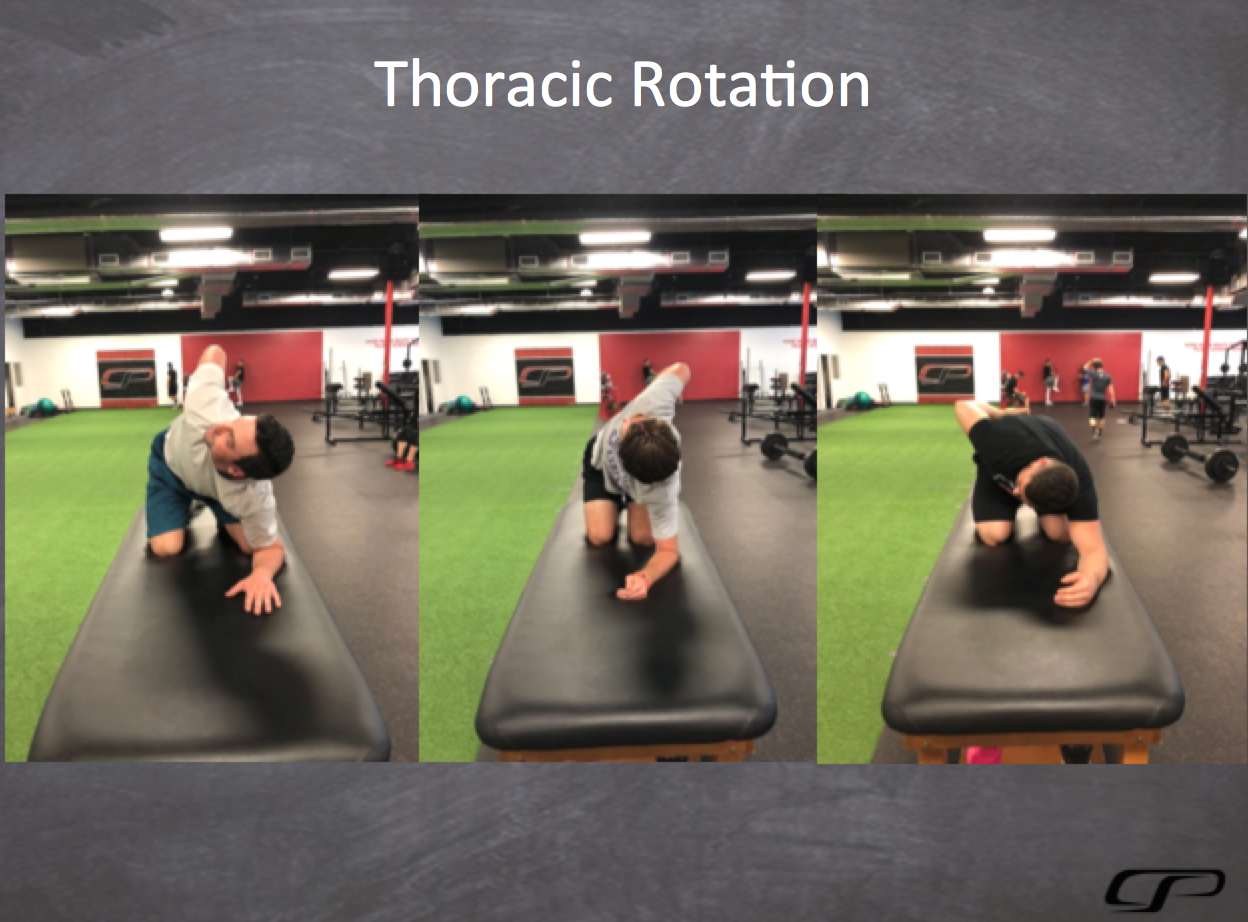
The second area where you really can’t go wrong is incorporating thoracic spine mobilizations.  The thoracic spine has direct interactions with the lumbar spine, rib cage, cervical spine, and scapulae; as a result, it has some very far-reaching effects. Unfortunately, most people are really stiff in this region – and that means they wind up with poor core and scapular stability, altered rib positioning (which impacts respiration), and cervical spine dysfunction.  Fortunately, mobilizing this area can have some quick and profound benefits; I’ve seen shoulder internal rotation improve by as much as 20 degrees in a matter of 30 seconds simply by incorporating a basic thoracic spine mobility drill.

That said, not all thoracic spine mobility drills are created equal.  Many of these drills require the glenohumeral joint to go into external rotation, abduction, and horizontal abduction in order to drive scapular posterior tilt/retraction and, in turn, thoracic spine extension and rotation. If you’ve got a cranky shoulder, this more extreme shoulder position usually isn’t going to go over well.  So, drills like the side-lying extension-rotation are likely out:

For most folks, a quadruped extension-rotation drill will be an appropriate regression:

And, if the hand position (behind the head) is still problematic for the shoulder, you can always simply put it on the opposite shoulder (in the above example, the right hand would be placed on the left shoulder) and keep the rest of the movement the same.

Last, but certainly not least, you can almost always work on forward head posture from the get-go with someone whose shoulder hurts.  We start with standing chin tucks, and then progress to quadruped chin tucks.

Additionally, working on cervical rotation is extremely valuable, although teaching that is a bit beyond the scope of this post.

Keep in mind that these three broad initiatives are really just the tip of the iceberg when it comes to a comprehensive corrective exercise plan that would also include a focus on scapular stabilization and rotator cuff exercises, plus additional mobility drills.  They are, however, safe entry-level strategies you can use with just about anyone to get the ball rolling without making a shoulder hurt worse in a strength and conditioning program.

For more information on what a comprehensive shoulder rehabilitation program and the concurrent strength and conditioning program should include, check out Optimal Shoulder Performance, a DVD set I co-created with Mike Reinold, the Head Athletic Trainer and Rehabilitation Coordinator of the Boston Red Sox.

The Optimal Shoulder Performance DVD is a phenomenal presentation of the variables surrounding shoulder health, function, and performance. It combines the most current research, real world application as well as the the instruction on how to implement its vast amount of material immediately. After just one viewing, I decided to employ some of the tactics and methods into our assessment and exercise protocols, and as a result, I feel that myself, my staff and my clients have benefited greatly.

Michael Ranfone BS, CSCS, LMT, ART
Owner, Ranfone Training Systems


A Great Read on Shoulder Instability

Written on March 30, 2011 at 6:39 am, by Eric Cressey

My next blog (which is one of the best things I’ve ever written, in my opinion – so don’t miss it!) will go live tonight, but in the meantime, I wanted to encourage you to check out a great two-part article from my buddy Mike Reinold, the head athletic trainer and rehabilitation coordinator for the Boston Red Sox (not to mention the co-creator of the Optimal Shoulder Performance DVD set).  Mike delves into shoulder instability in great detail:

Key Factors in the Rehabilitation of Shoulder Instability: Part 1

Key Factors in the Rehabilitation of Shoulder Instability: Part 2

Sign-up Today for our FREE Newsletter and receive a deadlift technique tutorial!

Name
Email

Lose Fat, Gain Muscle, Get Strong, and Laugh a Little – Installment 2

Written on March 2, 2011 at 7:48 am, by Eric Cressey

Time to learn and laugh – and hopefully lose fat and gain muscle in the process.

1. Here’s a great study that shows that scapular dyskinesis in swimmers is magnified as training duration increases.  I think that we all assume that you either have a scapular dyskinesis or you don’t – but the truth is that you may not have it at rest, but it can kick in with activity as you fatigue.  This is often why pitchers’ mechanics change (e.g., elbow drops) as they get tired later in an outing.

It’s a perfect example of how managing a pitcher – building up throwing volumes, charting pitch counts, and preparing the body – is much more important in terms of long term health than simply teaching pitching mechanics.  A pitcher might have great mechanics in a 15-30 pitch bullpen, but that can change dramatically if he is asked to extend his pitch count.

2. I woke up this morning to an email from two CP pro guys, Matt Kramer (Red Sox) and Chad Rodgers (Braves), and it included this video thank you/tribute from the off-season.  Not a bad supplemental skill set for a couple of guys who throw 95mph!

3. My wife and I have been doing more and more cooking from Dave Ruel’s Anabolic Cooking.  He’s got a ton of great (and healthy) recipes in this cookbook that have been a nice change of pace for us, as we seemed to have gotten in a rut when things got busy and we just kept preparing what was quick, easy, and familiar.  I’ll write up a thorough review of the product sometime soon, but for now, you can find out more information HERE.

4. On Monday, my wife and I returned from four days in Iceland.  It was an awesome trip; people there are so hospitable and we were treated fantastically.  I could go on and on about our experiences there, but a travel guide could tell you much more than I ever could – so I’ll just make an interesting observation…

On average, Icelandic folks live two years longer than those in the U.S.  This is in a country that a) gets far less vitamin D due to minimal sunlight and b) has very few resources when it comes to growing fruits and vegetables because almost the entire country is lava fields.  What do they have that we don’t? Portion control at meal time.

Speaking of meal time, I ate whale blubber, rotten shark, and ram’s testicle.  Not surprisingly, none of them were very good.

5. I saw this advertisement with Mick Jagger on it in a clothing store at a Reykjavik mall and just had to snap a picture.  Apparently, Jagger has 20-inch biceps in Iceland.

This was definitely one of the better Photoshop jobs that I’ve seen.  They really made it believable.  The only thing missing from the picture is the purple unicorn that Mick rode to the show.

6. My buddy John Romaniello was on Good Morning America the other day.  I was hoping he’d talk about the time that we ate moose meat sloppy joes together, but instead he talked about fat loss.  I think the sloppy joe story would have come out better, but his appearance still went pretty well.  Check him out.

Sign-up Today for our FREE Newsletter and receive a deadlift technique tutorial!

Name
Email

5 Reasons Direct Rotator Cuff Exercises are Necessary in a Strength Training Program

Written on February 16, 2011 at 8:36 am, by Eric Cressey

If you’ve read much of my stuff, you’ve probably come to realize that I’m quite the shoulder geek.  With that title comes a lot of questions at seminars and via email, and one of the more common ones is whether I think direct rotator cuff strengthening exercises are necessary for everyone.  A lot of coaches say that they aren’t essential, but I beg to differ for five reasons.  Here’s why:

1. Bad Posture – Nowadays, pretty much everyone has rounded shoulders – which means that the scapulae are winged out.  When a shoulder blade isn’t sitting right, the rotator cuff muscles that attach to that scapula are at a mechanical disadvantage because they are outside of their ideal length-tension relationship for creating force; it’s analogous to trying to shoot a cannon from a canoe.

Incorporating some direct rotator cuff exercises not only strengthens muscles that you know will be operating at a mechanical disadvantage, but also educates a lifter about how the scapula should be positioned for ideal shoulder function.

2. Shoulder impingement is a physiological norm.Research from Flatow et al. demonstrated that everyone – regardless of age, activity level, sport of choice, acromion type, gender, you name it – has direct impingement on their rotator cuff tendons.  If you know a region is going to get beaten up regardless of what you do in your life, why wouldn’t you opt to strengthen it proactively?

3. Rotator cuff tears are far more common than you think. – In consideration of the previous point, it should be no surprise that rotator cuff tears are actually far more common than one might realize – even if you look at asymptomatic subjects.  Connor et al. discovered that on MRI, 40% of asymptomatic tennis/baseball players had evidence of partial or full-thickness cuff tears.  The general population is no different; Sher et al. took MRIs of 96 asymptomatic subjects, finding rotator cuff tears in 34% of cases, and 54% of those older than 60.  And these studies don’t even include the ones who are actually in pain!  It makes sense to strengthen these areas proactively – even if your shoulder doesn’t hurt…yet.

4. Lots of people also have labral tears. – In the past, I’ve written quite a bit about Active vs. Passive Restraints.  In the shoulder, the rotator cuff would be considered an active restraint, as it’s something that can be strengthened to improve dynamic stability.  The labrum, on the other hand, doesn’t get stronger with exercise; it’s a passive restraint that provides stability.  So, if the labrum is torn or frayed (as it very commonly is in both lifters and overhead throwing athletes), then the active restraints – the rotator cuff tendons – need to pick up the slack.

5. The “Just do normal stuff and the rotator cuff will take care of itself” philosophy isn’t working. - That’s been tried for quite some time, and nowadays, as a society, we move like absolute crap and – as noted above – have a boatload of issues on MRI even if we’re asymptomatic.  With respect to the cuff, we’ve built the deltoids up to the point that they absolutely overwhelm the rotator cuff (particularly the supraspinatus), which is trying to prevent the humeral head from migrating upward into the acromion.

My article, Clearing up the Rotator Cuff Controversy demonstrates some of our favorite rotator cuff exercises and talks about how to include them in a weekly strength training program.

For more information, check out the Optimal Shoulder Performance DVD Set.

Sign-up Today for our FREE Newsletter and receive a detailed deadlift technique tutorial!

Name
Email

Stuff You Should Read: 1/31/11

Written on January 31, 2011 at 6:07 am, by Eric Cressey

Testing, Treating, and Training the Shoulder – This recap of my seminar with Mike Reinold features ten important takeaways from the day.

You Are What You Absorb – I thought this was an excellent article from John Meadows – both in terms of the background information he provides and the corrective strategies he advocates.

Rollouts: Friend or Foe and Two Anterior Core Progressions – These two video blogs were quite popular when they ran back in 2009.

Sign-up Today for our FREE Newsletter and receive a detailed deadlift technique tutorial!

Name
Email

High Performance Training Without the Equipment: 6 More Pushup Variations

Written on January 21, 2011 at 4:45 am, by Eric Cressey

In yesterday’s post, I outlined the importance of including pushup variations in your strength training program and introduced five ways to progress this basic exercise. Today, I’ve got six more pushup variations for you.

Pushup Variation #6: Yoga Pushups

I like Yoga pushups not because they are a subtle increase in difficulty over a regular pushup, but because they afford some extra mobility benefits at the ankles, hips, and thoracic spine.  They’re a great addition to a dynamic warm-up.

Pushup Variation #7: Spiderman Pushups

While it increases the difficulty a bit more than a yoga pushup, the spiderman pushup still affords some great hip mobility benefits.

One word of caution, though; it’s my experience that folks tend to “slip” into a forward head posture more often with the spiderman pushup than any other pushup variation, so make sure that you don’t let the head poke forward as the elevated leg’s hip goes into flexion and abduction.

Pushup Variation #8: Slideboard Pushup Variations

We utilize the slideboard a ton at Cressey Performance – and pushups are no exception.  Two of our favorites are slideboard pushups with band and slideboard bodysaw pushups.

In the case of the former, we take a 1/2″ band and wrap it around the wrists.  This band wants to pull you into internal rotation and horizontal adduction at the shoulder, so you have to activate the posterior rotator cuff and scapular retractors to hold the ideal pushup position.

The bodysaw pushups really take things up a notch on the difficulty scale, as they not only make the hand positioning dynamic, but also increase the anti-extension core challenge.

Pushup Variation #9: Pushup Iso Hold w/Perturbations

In our DVD set, Optimal Shoulder Performance, Mike Reinold and I spend quite a bit of time talking about the value of rhythmic stabilization drills to train the true function of the rotator cuff.  I’m also a big fan of pushup isometric holds to teach proper scapular positioning and educate athletes on ideal posture.  In the 1-leg pushup iso hold with perturbations, we get all those benefits – plus some added instability training because there are only three points of contact with the ground.

Pushup Variation #10: TRX Pushups

The TRX is probably the most versatile piece of equipment out there other than the barbell and the functional trainer – and one of its most basic uses is pushup variations.

As I alluded to in my e-book, The Truth About Unstable Surface Training, the instability created by the TRX likely allows you to maintain muscle activation in the upper extremity even though less loading is needed.  This means that when performed correctly, TRX pushups may have a place in a return-to-function protocol after rehab, or even simply as a deloading strategy in a strength and conditioning program.

For more information, check out the Fitness Anywhere website.

Pushup Variation #11: T-Pushups

Last, but certainly not least, we have the T-Pushup.  This pushup variation is great because it not only involves constant changing of the points of stability, but also because it requires thoracic spine rotation.  To increase the challenge, you can hold dumbbells in your hands.

I’ve listed 11 variations in the past two posts, but I know that a lot of you out there have some innovative pushup variations to suggest as well.  Let’s hear ‘em in the comment section!

Sign up for our FREE Newsletter today and and receive this deadlift technique video!

Name
Email

High Performance Training without the Equipment: 5 Pushup Variations

Written on January 20, 2011 at 8:07 am, by Eric Cressey

I’ve written several times in the past about how it’s important to not only balance your upper body pushing and pulling exercises, but also make sure that you have a similar volume of open- and closed-chain exercises in the pushing component.  In other words, you need to have plenty of pushup variations to “cancel out” all  the bench pressing variations in your strength training program.

There’s a problem, though; most of you can do a ton of pushups, and are in need of something more challenging that can take this beyond simply a warm-up.  With that in mind, I wanted to use today’s post to highlight some pushup variations we use quite frequently at Cressey Performance.  While a few might require some of the cooler amenities (e.g., chains, slideboard) we’ve got at our fingertips, most are drills you’ll be able to perform without them.  Without further ado, here are five pushup variations to throw some variety in your strength and conditioning program.

Pushup Variations #1 and #2: Feet Elevated and Band Resisted Pushups

I combine these two not only because they were both in the same video that I’d taken for Show and Go, but also because they represent two of the most convenient solutions for the typical lifter.

Elevating the feet not only makes the movement a bit more challenging from an anti-extension core training perspective, but it also increases activity of the serratus anterior, as I wrote HERE.  Believe it or not, while this modification makes the movement harder as a whole, it can often take away symptoms completely in some folks with shoulder pain.

In the case of the band-resisted pushup variation, the resistance accommodates the strength curve.  In other words, the band deloads at the bottom of the movement where you’re the weakest, and picks up resistance as you go further up toward the top of the movement, where you’re the strongest.

Pushup Variation #3: Chain Pushups

Okay, this one will require you to have some equipment, but trust me when I say that if you do decide to get some for your home gym set-up, you’ll use them over and over again – and not just for pushup variations!  As with the bands progression above, chain pushups are a form of accommodating resistance; the load is heavier where you’re strongest.  I also like chains because they allow you to quickly and easily modify resistance on the fly for drop sets or to simply make the exercise easier as a set progresses.  And, they can be pretty challenging:

Let’s assume conservatively that you’re lifting 60% of your body weight with a pushup.  At 190 pounds, that’s 114 pounds for me.  When you combine it with 10 chains at 15 pounds each, you’re looking at about 264 pounds of resistance.  Who says you can’t load up a pushup?

Pushup Variation #4: 1-leg Pushup Variations

One quick and easy way to make any exercise harder is to reduce the number of ground contact points.  On a normal pushup, you have four (both hands and feet).  Simply taking one foot off the floor not only increases the loading on the upper body, but also imposes a subtle anti-rotation challenge to your core.  You can do it feet-elevated, too:

Of course, you can combine the 1-leg pushup with external loading, too:

Pushup Variation #5: 1-arm Push-ups

Sticking with the theme of reducing the numbers of points of stability, you can go to one-arm pushup variations as well.  You don’t have to be diesel enough to do these from the floor to get the benefits, though; you can simply press from a pin in a power rack.

As you get stronger and more comfortable with the movement, you can move the pin down to increase the challenge.

Start thinking about how you can integrate these in your strength training program, and I’ll be back soon with five more pushup variations you can use to take things even further.

Sign-up Today for our FREE Newsletter and receive a detailed deadlift technique tutorial!

Name
Email

All Young Athletes are “Injured” – even if they don’t know it

Written on January 7, 2011 at 7:27 am, by Eric Cressey

I’ve written quite a bit in the past about how one should always interpret the results of diagnostic imaging (MRI, x-ray, etc.) very cautiously and alongside movement assessments and the symptoms one has.  In case you missed them, here are some quick reads along these lines:

Preventing Lower Back Pain: Assuming is Okay
Who Kneeds “Normal” Knees?
Healthy Shoulders with Terrible MRIs?

While some of these studies stratified subjects into athletes and non-athlete controls, not surprisingly, all these studies utilized adult subjects exclusively.  In other words, we’re left wondering if we see the same kind of imaging abnormalities in asymptomatic teenage athletes, which is without a doubt our most “at-risk” population nowadays.

That is, of course, until this study came out: MRI of the knee joint in asymptomatic adolescent soccer players: a controlled study.

Researchers found that 64% of 14-15 year-old athletes had one or more knee MRI “abnormalities”, whereas those in the control group (non-athletes), 32% had at least one “abnormality.”  Bone marrow edema presence was markedly higher in the soccer players (50%) than in the control group (3%).

Once again, we realize that just about everyone is “abnormal” – and that we really don’t even know what “healthy” really is.  So, we can’t hang our hat exclusively on what a MRI or x-ray says (especially since we don’t have the luxury of knowing with every client/athlete we train).  What to do, then?

Hang your hat on movement first and foremost in an asymptomatic population.  Do thorough assessments and nip inefficiencies in the bud before they become structural abnormalities that reach a painful threshold.

Sign-up Today for our FREE Newsletter and receive a detailed deadlift technique tutorial!

Name
Email

New Balance

Featured Product
Assess and Correct

YouTubeTwitterFacebook