



Master the King of All Exercises

Deadlifting Secrets 101

Everything you need to know about this complex exercise.

Free Video Training

Name:
Email:* 
Show and Go

Show and Go: High Performance Training to Look, Feel, and Move Better


The Truth About Strength Training for Kids

Written on December 7, 2009 at 7:00 am, by Eric Cressey

A while back, I attended a seminar in Houston, and while the primary topic was how to improve pitching performance, one of my biggest takeaways was with respect to adolescent physiological development.  Long-time Phillies rehabilitation consultant Phil Donley presented some excellent data on when bones actually become skeletally mature.  The next day, another speaker made a what was, in my opinion, an uninformed comment about how kids shouldn’t strength train at young ages because it would stunt their growth.

Let’s start with Donley’s very intriguing numbers (which have actually been available in the literature for over two decades now); we’ll stick with the shoulder girdle just to keep things to-the-point.  In a baseball population, the epiphysial plate most commonly injured from throwing at the shoulder is located at the proximal humerus (Little League Shoulder); this physis (growth plate) accounts for about 80% of humeral growth, and matures by age 19 in most folks.
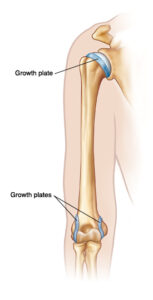
growthplates

We’ve seen a lot of kids come through our door with this issue because of throwing (internal rotation of the humerus during throwing is the fastest motion in sports) and even some traumatic falls – but I can honestly say that I’ve NEVER seen one from strength training.  So, anecdotal evidence for me shows that strength training for kids is far from what could be considered “dangerous” for developing bones.

youthpitcher

Now, here’s where it gets more interesting: bone maturation isn’t uniform across the body.  While the proximal humeral growth plate might mature at 19, the distal (down by the elbow) physis is finished between ages 10 and 16.  The proximal and distal radius plates might mature anywhere between 14 and 23.  Meanwhile, the clavicle matures at ages 22-25, and the scapula generally matures by age 22.  How many of you have ever heard of a college football being held out of weight training for all four years of his participation because all that bench pressing might stunt the growth of his clavicles and scapulae?  It just doesn’t happen!  In reality, we know that the strength training benefits of increased muscle size and strength actually protect him from injury on the field.

photos_sports_youth-football001

In other words, violent (throwing) and traumatic (falling) events far exceed any stress on a young athlete’s bones that we could possibly apply in a strength training setting, where the environment is controlled and overload is gradually and systematically increased over time as the athlete becomes more comfortable with it.  I’d make the argument that a young athlete should start resistance training as early as his/her attention span allows for it; the emphasis, of course, would be on body weight exercises, technical improvement, and – most importantly – keeping things fun.

If you really think about it, an athlete is placing a ton of stress (4-6 times body weight in ground reaction forces, depending on who you ask) each time he/she strides during the sprinting motion.  Kids jump out of trees all the time.  They lug around insanely heavy backpacks relative to their body mass.  Performance, general health, and self-esteem benefits aside, it’s only right to give them a fighting chance in trying to avoid injury.

Also, another great point Phil made (although it was on an unrelated topic, it pertains to us) was that as an adolescent athlete grows, his center of gravity moves further up from the ground.  This is a big part of the “lapse” in coordination we see in kids during their growth spurts.  A little bit of strength goes a long way with respect to maintaining the center of gravity within the base of support, and makes an athlete more comfortable “playing low” (hip and knee flexion) to bring that center of gravity closer to the base of support.

All that said, appropriate resistance training is not only safe for kids; it’s also tremendously beneficial.  In a review just published by Faigenbaum and Myer, the authors concluded:

Current research indicates that resistance training can be a safe, effective and worthwhile activity for children and adolescents provided that qualified professionals supervise all training sessions and provide age-appropriate instruction on proper lifting procedures and safe training guidelines. Regular participation in a multifaceted resistance training program that begins during the preseason and includes instruction on movement biomechanics may reduce the risk of sports-related injuries in young athletes.

Dr. Avery Faigenbaum has actually published a ton of great research (including position stands for numerous organizations) on the topic of strength training for kids in recent years; you can find all of it by searching for his last name at www.pubmed.com.

In the meantime, I hope this blog can help to eliminate the gross misconception in the general population that resistance training can’t be beneficial for children.  When performed correctly and made fun, it is safe and provides tremendous benefits to kids in both the pre-adolescent and adolescent stages.

Sign-up Today for our FREE Baseball Newsletter and Receive a Copy of the Exact Stretches
used by Cressey Performance Pitchers after they Throw!


Name
Email

22 Responses to “The Truth About Strength Training for Kids”

  1. Nick Koproski Says:

    It gets frustrating sometimes to hear exercise “myths” being practiced/preached as the norm today. Makes no sense that children cannot practice specified resistance training, yet they roll around, fall down and jump off things. Mabye one day this misconception will be six feet under. Dr. Avery Faigenbaum is the man.

  2. Kevin @ Team KUSA Says:

    Eric,

    I am the coach of a National Level Olympic Taekwondo team. Our athletes range between the ages of 8 and 14 right now. Can you please guide me on when we should start resistance training with them and how much/often?

    I’ve wanted them to do it but I don’t know enough about child physiology in regards to resistance training at this point.

    They do extremely difficult workouts for speed, agility, coordination, balance, and power, but we haven’t yet incorporated resistance (other than “rip cord” resistance bands that go on the leg when they practice their kicks or the myoplex kinetic bands when working for speed and explosiveness.

    Please give me some advice. Thanks!

  3. Derek Says:

    Thanks for a great article on a topic near to my heart.

  4. TJ Says:

    If anything, the earlier the better when it comes to establishing an extremely solid foundation. With proper instruction and fun (as noted) early on, it can only mean great things for the future, and that’s not even taking into account the relation to future sports participation.

    Get kids moving properly (or more precisely help them to maintain what they had as a baby, some might say), and teach them to enjoy physical activity while appreciating the need to progressively challenge themselves, and any benefits would be incalculable.

  5. Natalie Says:

    I love this blog. I couldn’t agree more that children to practice great and successful workout regiments aswell as adults. It is what keeps our youth strong and healthy. It also teaches discipline and responsibility to want to reach a goal. Children don’t certainly understand they are exercises if you can make it fun for them. They feel it is more of a game. We need our young ones to strive and challenge themselves. Great stuff can’t wait to read more.

  6. Rich Says:

    Mel Siff revisited.

    It’s surprising to hear that a lecturer in 2009 still believes this.

  7. Mik Says:

    How in the world are people going to give good counsel to kids if they don’t know squat about what they are doing themselves? If you pay the monthly at a exercise factory, you know that the kids who pass for trainers are telling people to do fifteen different bicep exercises, fifteen reps of eight series. You know they say nothing to the guy doing pulldowns behinds his neck. They say nothing to the guy doing curls in the squat rack. They are there to make sure the women don’t get bulky, and to make sure that no one ever squats or deadlifts. You would not want your pulse to accelerate now would you?

  8. jerry weinstein Says:

    Wolff’s Law validates the value of overload & it’s effect on bone growth(density).

    In the early days of baseball, players were known to be “country strong” as a result of their work on the farm in their primative years.

    JW

  9. Rick Kaselj Says:

    .

    EC,

    Great post.

    It is difficult to put all these groups together:
    - Children in a weightroom seeing what the maximum is they can lift
    - Children that read something on the internet about strength training for performance
    - Children in a periodized supervised program

    Rick Kaselj of http://www.ExercisesForInjuries.com

    .

  10. Derek Shore Says:

    Great article Eric – Years ago I had the good fortune to work with Phil Donley while I worked for the Phils. He essentially designed possibly one of the most complete shoulder routines at that time. With his consultation, our athletic trainers were able to consistently determine whether a player would blow out his elbow or shoulder. These were professionals as young as 17, not amateurs. I’ve seen players ignore the warnings from the trainers and ruin their careers over it. If anything, lifting weights can only help athletes get stronger and more stable where it matters. If this is not a strong enough statement for the advocacy of using weights with youth, I don’t know what is.

  11. Eric Cressey Says:

    Kevin,

    It’s a bit of a tough question to answer specifically. I just always remind people that it’s “resistance training,” not just “weight training.” You can use body weight stuff, bands, free weights, manual resistance, you name it. The goal at those ages is to master technique and keep it fun – and once those two goals are accomplished, you can start looking to progressively increase resistance.

    My hunch is that given the body control martial artists tend to have, they’ll be able to handle some additional loading sooner than the typical kids their age.

  12. Darrick Ervin Says:

    Good Article. Unfortunately this myth is widely spread around the world.

  13. jon Says:

    Great article! I would agree that the original person that questioned the safety of adolescent weight training was very uneducated. As a physical therapist, we need to try and change the exercise science/ physical therapy professions. It is entirely too easy to call yourself an expert now days. Just because you “call” yourself a trainer does not mean that you have any more knowledge than a person that reads a few magazine articles on exercise. Look for a trainer that is certified by either the NSCA (national strength and conditioning association) or the ACSM (american college of sports medicine). Also, We as fitness and physical therapists need to try and educate the general public on the principles of proper fitness, training, and rehabilitation.

  14. Lisa Says:

    Glad to see this one exploded.I spent my summer holidays on my grandad’s farm in Ireland and my age and size was not taken into account when piking straw and hay bales (which must have weighed at least 40kg) off the ground on a pitchfork and into a trailer, or when hauling rocks out of the ground so we could get the ground ready for sowing, or chopping big logs or flipping tires across the yard so their dad could change a flat. My cousins were the strongest, most athletic kids I’ve ever seen. They are in their 40′s now and play hurling 5 days a week and work dawn till dusk on their farms. Their fitness and strength would put guys and women half their age to shame

  15. Matt Carlin Says:

    Guys check the Australian Strength & Conditioning Position Stand on Resistance Training for Children & Adolescents. Very thorough and well researched by some of Australia’s leading S&C Coaches.

    http://www.strengthandconditioning.org/content.aspx?clID=/default.aspx&ID=195

  16. Matt Carlin Says:

    Guys check the Australian Strength & Conditioning Position Stand on Resistance Training for Children & Adolescents. Very thorough and well researched by some of Australia\’s leading S&C Coaches.

    http://www.strengthandconditioning.org/content.aspx?clID=/default.aspx&ID=195

  17. Steve Vieraa Says:

    Good article! I have had my 6yo son in gymnastics for about two years. I think the benefits from gymnastics will provide many benefits for physical progression from here on out. Lots of jumping, stretching and tumbling, plus balance, coordination, body awareness and strength development from bodyweight stuff. So I believe :)

  18. Jeff Beard Says:

    Eric, Could not agree with you more about strength training with kids. I have taken classes from Avery and I have been working with kids (age 8 and up) for a long time now and have never had an issue mainly due to I strongly supervise their form and technique and do not allow them to lift too heavy of resistence. Thanks.
    Jeff Beard

  19. Gordon Wayne Watts Says:

    I’m glad you gave hard facts on exercise and youth –I actually didn’t know for sure.

    Anyhow, these myths about “kids can’t lift weights” are not unlike *other* stupid myths I’ve recently heard:

    *** Women will look like men if they lift heavy.

    *** Supermarket milk does the body good.

    Caveat: That 2nd MISstatement is not so obvious, but see team websites to verify this this –and don’t take my word, but see and believe:

    ** http://NotMilk.com

    http://GordonWatts.com/#health

    http://GordonWayneWatts.com/#health

    – or, if you’re feeling lucky: Google milk and cancer … one thing is sure: NO actual studies (peer reviewed scientific studies) have found ANY type of milk is good — they just don;t always agree on which type (skim, 2%, etc.) is most poison.

    Sorry to rant … but other countries KICK OUR BUTT in cancer rates, life-span, etc.

  20. Rees Says:

    To date, I still think this is probably one of your better pieces.

    I’m amazed at how many people are still worried about such things.

  21. Tony Dague Says:

    Adolescent female deficit in strength to weight ratio-a recipe for ACL injury. If we could somehow get the kids to strength train rather than when after injuries occur.

  22. Greyson Peltier Says:

    Is the car pushing part of the Cressey training system for kids? :)

Leave a Reply

Security Code:


Cressey Performance
Post-Throwing Stretches

Learn the Exact Flexibility Exercises Used by Cressey Performance Pitchers after they Throw.

Name:*
Email:*
New Balance

Featured Product
Assess and Correct

YouTubeTwitterFacebook