



Master the King of All Exercises

Deadlifting Secrets 101

Everything you need to know about this complex exercise.

Free Video Training

Name:
Email:* 
Show and Go

Show and Go: High Performance Training to Look, Feel, and Move Better


Weighted Baseballs: Safe and Effective, or Stupid and Dangerous?

Written on December 15, 2009 at 7:43 am, by Eric Cressey

I get asked relatively frequently whether we use weighted baseballs with our pitchers, and if so, how they are incorporated.  I figured it’d be worth a post to outline my thoughts.  To answer these questions:

Do you use weighted baseballs?

Yes, with some of our pitchers.  The asterisk that follows this statement is that they’re only implemented with those who have built a decent foundation of strength and mastered the fundamental mechanics of throwing a regular (5oz) baseball.  So, the athletes we have that may be utilizing weighted baseballs are some of our pro guys, college guys, and more advanced high school guys.  It is NOT something I think coaches should just implement on a gross scale with unprepared 13-year-old kids.
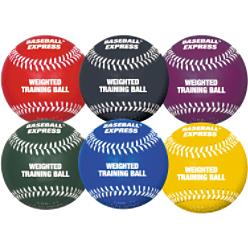
weightedballs

But aren’t weighted baseballs dangerous?

The first response that comes to mind is “Who decided a baseball should be 50z?”  It’s actually a very arbitrary number.

Quarterbacks throw 14-16oz footballs (140z is the dry weight; balls actually become heavier as they’re used more).  And, you could say that a lot of quarterbacks throw every day – and potentially even more than pitchers throw.  Yet, they have far fewer elbow and shoulder problems than pitchers – and usually far less coaching on the mechanics of throwing than pitchers.

drew-brees-5

Granted, there are differences in the way that footballs are thrown, as compared to baseballs, but you have to consider that tripling the weight of the ball would increase arm stress, right?  Wrong!

If you increase the weight of the implement, you slow down the arm action.  In other words, you move further to the right on the absolute speed>>>>absolute strength continuum.  In other words, weighted baseballs comprise a medium between traditional throwing drills (bullpens, long toss, flat ground drills) and what one encounters with medicine ball work and resistance training.  If you slow down the arm action a bit, the deceleration demands drop – and it appears to be more arm-friendly.

How are weighted baseballs incorporated?

First, let me make two things abundantly clear:

1. You should never throw a weighted baseball off a mound (arm stress is higher when elevated) or with long-toss.  We do all our weighted ball drills into a tarp/net from about 6-8 feet away.

2. You don’t play catch with weighted baseballs.  Someone will get hurt if you try.  Throw the ball, then walk to pick it up.

We don’t start throwing weighted baseballs until we’ve built guys up on their long tossing and the arm is 100% ready.  In other words, weighted ball work starts up right around the time that bullpens start.  As an example, most of our guys start throwing right after Thanksgiving, and pick up bullpens around January 10 after about 5-6 weeks of long-tossing and flat-ground drill work with the 5oz ball.  The entire throwing program for them encompasses about 14 weeks (sometimes a bit longer or shorter, depending on the individual).

As an example, as I wrote previously, we used weighted balls with Oakland A’s minor league prospect Shawn Haviland last off-season, and he made a nice velocity jump from 87-88 to 90-94 in a single off-season.  Looking back at Shawn’s program, his first session with weighted baseballs was January 11, and his last one was February 18th – so it wasn’t something he was doing year-round or in-season.
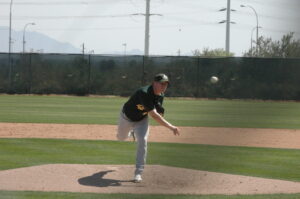
ap-shawn-haviland-action

We have, however, had scenarios where guys have used weighted baseballs to get ready for fall throwing appearances (for example, the World Wood Bat Tournament in Jupiter, FL every October).  These guys push their winter throwing programs back because they accumulated mileage on their arms in the fall (one reason I don’t love fall baseball, but it’s part of the game as it’s played nowadays).

When the time comes to implement the weighted baseball drills, they are either done as after long toss, after a bullpen, or as a stand-alone training session.  They are never done before a bullpen, which comprises complete specificity with which you don’t want to interfere.

All of our weighted baseball drills generally take place in the 7-11oz range.  I do, however, know some very bright minds in the field who will go heavier.

We always bring the athlete back to the normal 5oz ball at the end of each set.  So, it might be three throws at 7oz, three throws at 9oz, and then three throws at 5oz, then rest.  Other coaches may build all the way up (five at 7oz, five at 9oz, and five at 11oz) and then work their way back down to 5oz at the end of the session.  Personally, I prefer to keep the learning loop short and keep the athlete cognizant of the 5oz feel with repeated sets as opposed to one big one.

Matching the drill to the weight of the ball is absolutely imperative, too.  As a general rule of thumb, I do not go above 8oz for any drill that has a considerable lay-back (as pictured below) component, as the stress on the elbow is already pretty high in this position.

wagner

We can go considerably heavier with drills that are more focused on what’s happening out in front of the body, though.
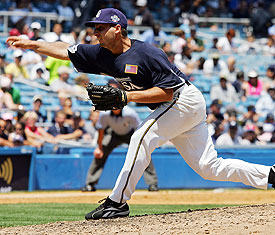
inman

Which weighted baseballs do you use?

We use this set from BaseballExpress.com; it includes 7-12oz balls, which is sufficient for most individuals.

Sign-up Today for our FREE Baseball Newsletter and Receive a Copy of the Exact Stretches used by Cressey Performance Pitchers after they Throw!

Name
Email

14 Responses to “Weighted Baseballs: Safe and Effective, or Stupid and Dangerous?”

  1. Eric Lepine Says:

    Great article Eric, as always. I’d be curious to hear your thoughts (maybe within the context of a future article???) on the biomechanical differences between the throwing motion of a baseball pitcher and as a quarterback and, with that in mind, the various approaches to training the latter. The mention of how throwing a football is more to “the right on the absolute speed>>>>absolute strength continuum” piqued my curiosity and would seem like a good start :-)
    Cheers

  2. Sean Says:

    Another well thought and informative article. I work with a couple quarterbacks and have implemented some baseball throwing programs with success.
    Each training camp it’s always a battle with the coaching staff to try and ease their way into throwing, but to little success. Our quarterbacks throw between 150-200 balls each day in practice. Training camp lasts 12-14 days consecutive, so I’ve dealt with these guys with sore shoulders and arm consistently.
    What thoughts or experience do you have with football quarterbacks that may differ from your work with pitchers.
    Sean

  3. tom Says:

    How does wagner create such tremendous “lay back”, does the sleep stretch help to recieve a whipping action when a person throws? Or is it all about muscle flexability in the elbow?

  4. Eric Cressey Says:

    Eric and Sean,

    Definitely some points for a future article, but in the meantime, you might like this:

    http://ericcressey.com/pitchers-vs-quarterbacks-vs-swimmers

  5. Eric Cressey Says:

    Tom, check this article out:

    http://ericcressey.com/newsletter105html

  6. Derek Shore Says:

    Well done Eric. As you stated, players have to have a solid base of long toss under their belts, but I’m curious as to what your strength standards/look-fors are for a ball player to move up to using weighted balls?

  7. sifter Says:

    I always thought the mantra was NOT to use a weighted implement with skill training, that it would throw off your timing, speed, etc. Rather one should 1)get strong, and 2)practice the skill, two seperate endeavors. Where am I wrong?

  8. Brandon Says:

    Eric–So you would throw the balls into a net 6-8 feet away? Why so close?

  9. mark schmid Says:

    Do you incorporate any underweight balls into your program?

  10. Bo Bertino Says:

    I think there is much more important work to be done than use weighted balls. There is no scientific proof it helps and the thought of the extra stress and possible timing interference scares me. the kid who increased his velocity might have been ready to increase his velocity with other training. I still am thankful for the article as it is thought provoking.

  11. Jeff Johnson Says:

    Excellent article on the weighted balls. We perform the pronation drills taught by Coach Wolforth, which use weighted balls. Just this evening my son and I viewed a DVD of Trevor Bauer using a four pound ball as demonstrated at the 2011 Pitching Coaches Boot Camp and I told my 14 year old he wasn’t ready for that. He agreed. We do not use the underload ball. I believe it puts more stress on the elbow and the benefit gained by this may not be worth the risk – at least until I’m convinced we have more consistent mechanics on the mound.

  12. Rich Says:

    Eric, I like most of what you suggest for weighted ball use, however, you mak no mentioned of using balls less than 5oz. I’ve done some studying of this topic and have some thoughts to balancing with overload and under load weighted balls in order to improve the deceleration muscles which as you probably know are one of the contributors to increased velocity….meaning the faster I can decelerate the faster the arm action resulting in higher velocity. I’ve also read studies the max weight to work with should be no more than 10-12% above/below the 5oz weight…so basically use a 6-7oz OR 3-4oz weighted ball. I would also debate using weighted balls for long toss. There are sand filled weighted baseballs which can contribute to long toss workouts and are safer to use than solid weighted baseballs. These can be purchased at http://www.Oatespecialities.com….hope this helps. Thanks for your perspective on such a delicate and complex subject.

  13. Eric Cressey Says:

    Bo,

    Actually, there absolutely IS scientific proof. Here is just one such example that is actually a meta-analysis describing the collective outcomes of all those studies:

    http://www.ncbi.nlm.nih.gov/pubmed/10783901

    Of particular note, “Data from these training studies strongly support the practice of training with overweight and underweight baseballs to increase throwing velocity of regulation baseballs.”

  14. Eric Cressey Says:

    Jeff – I really like Ron and Trevor’s stuff (actually had breakfast with them this past weekend). The underload ball does scare me, though, as I think arm speed is high enough at 5oz.

Leave a Reply

Security Code:


Cressey Performance
Post-Throwing Stretches

Learn the Exact Flexibility Exercises Used by Cressey Performance Pitchers after they Throw.

Name:*
Email:*
New Balance

Featured Product
Assess and Correct

YouTubeTwitterFacebook